Early Mathematics Learning
This overview emphasizes the importance of high-quality mathematics education for young children. It advocates for a playful and exploratory approach, where children engage mathematically through their experiences rather than through rote learning. By encouraging children to think mathematically and share their ideas, educators can nurture their curiosity and excitement about math. Discussions among teachers and stakeholders are crucial for transforming early mathematics education through research-based practices. Consider the impact of intentional play-based learning on children's mathematical development.
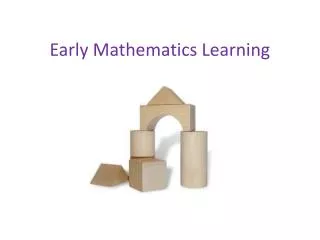

Early Mathematics Learning
E N D
Presentation Transcript
Early Mathematics LearningEntering the conversation Read the following quotes... What resonates for you? Turn and talk to an elbow partner...
“Young children love to think mathematically. They become exhilarated by their own ideas and the ideas of others. To develop the whole child, we must develop the mathematical child…” “High-quality mathematics throughout early childhood does not involve pushing elementary arithmetic onto younger children. Instead good education allows children to experience mathematics as they play in and explore their world.” Learning and Teaching Early Math: The Learning Trajectories Approach, Clements and Sarama, 2009
Early Math LearningDoug Clements on Early Math View (or insert) last clip from http://resources.curriculum.org/secretariat/snapshots/doug.html
Continuing the conversation.In table groups… • What confirmed your current thinking? • What challenged your current thinking? • What are your wonderings?
M4YC Literature Review, p. 13, 2012 Bruce, Flynn, Moss “...teachers, curriculum developers, district personnel, researchers and policy makers, need to transform their approaches to mathematics education by supporting, developing and implementing research-based practices.”
What could mathematics education for young children look like? Lessons from the research. • Number off 1 to 5 at your table • Read the corresponding section • Share with your colleagues... • What confirmed your thinking? • What challenged your thinking? • What are your wonderings?
Intentional Play-based LearningDoug Clements on Early Math View or insert second clip at located at http://resources.curriculum.org/secretariat/snapshots/doug.html
What aspects of Early Math Learning are well established in your classroom/school/family of schools/district? How do you know?Where might you/your colleagues next focus? Why?
Access to Resources www.edugains.ca/newsite/lns/index.html sim.abel.yorku.ca
Ministry Steering Committee LNS, Early Learning, Capacity Assessment Policy Branch • Research Design Team • Cathy Bruce, Tara Flynn, Trent University • Joan Moss U of T • Ruth Beatty, Lakehead • Beverly Caswell, Robertson Foundation • Kawartha Pine Ridge DSB 3 school teams • Simcoe Muskoka Catholic DSB, 1 school team • Toronto DSB, 4 school teams • Board Teams
Some Key Findings – M4YC • The most effective math programs include a spectrum of activities from play through to small group work, structured learning opportunities and direct instruction. These structures for learning are combined for daily concentration on mathematics learning that is purposeful and math specific.