Understanding Non-Fiction: Exploring Its Importance and Characteristics
Non-fiction encompasses written works that present factual accounts of real people, events, and places, including essays, autobiographies, and memoirs. Unlike fiction, non-fiction texts are characterized by features such as structured headings, varying fonts, and the incorporation of graphic aids like maps and diagrams to enhance understanding. Readers are drawn to non-fiction for its informative nature, offering insights into reality. This discussion invites reflection on personal experiences with non-fiction literature and its distinct characteristics compared to fiction.

Understanding Non-Fiction: Exploring Its Importance and Characteristics
E N D
Presentation Transcript
Introducing Non-Fiction What is it? Why read it?
What’s so special about non-fiction • Why do people read non-fiction? • Discuss
Non-fiction • Non-fiction-(from the Latin, "not" + "shaping, feigning) • Prose accounts of real people, places, objects, or events. Types of non-fiction include essays, autobiographies, biographies, and memoirs. • http://grammar.about.com/od/mo/g/nonfictionterm.htm • Written works intended to give facts, or true accounts of real things and events. • http://www.allwords.com/word-non-fiction.html
Characteristics of Non-fiction • How does non-fiction text look different from fiction? • There may be chapter titles and section headers that preview information. • Each page has works in a variety of fonts and type sizes • Bold or italics fonts may be used to signal important words or phrases • Diacritical marks may be used to guide pronunciation.
Non-Fiction Characteristics cont’ • How are graphic aids used? • Maps, charts, diagrams, photographs are usually included to illustrate or summarize information. • Captions or labels must be examined carefully for relevant information.
Non-fiction Characteristics Cont’ • How is the vocabulary different? • There may be more words that are unfamiliar. Look for multi-syllabic words like “photosynthesis” that may be difficult to pronounce. • What do we know about non-fiction? • There is a great deal of information to be understood & remembered
Non-Fiction Discussion: What books about real people, places, and events have you read? Do you enjoy reading these types of books? Why or why not? When you look at an article or biography, do you look at the illustrations and read the captions? What websites do you visit? Have you ever had to read directions for a board game or ingredients in a cookbook?
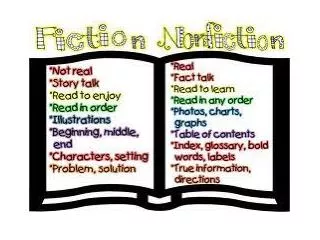
Refereces • Non-fiction chart http://www.scholastic.com • Plan:http://www2.scholastic.com/browse/lessonplan.jsp?id=230 • Google images