Download
1 / 7
70 likes | 184 Vues
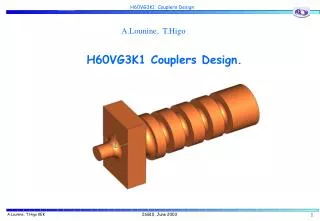
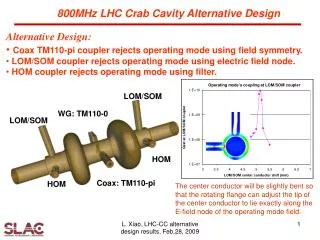
This document presents an alternative design for the 800 MHz crab cavity, focusing on higher-order mode (HOM) coupling strategies. The TM110-pi HOM coupler efficiently rejects operating modes using field symmetry, while the LOM/SOM coupler leverages electric field nodes to enhance performance. A unique feature is the slightly bent center conductor, which allows for precise adjustment to align with the E-field node, optimizing coupling efficiency. The design addresses multipacting issues related to resonant electrons within the cavity and includes detailed results from experimental studies.

E N D
LOM/SOM LOM/SOM WG: TM110-0 HOM Coax: TM110-pi HOM 800MHz LHC Crab Cavity Alternative Design Alternative Design: • Coax TM110-pi coupler rejects operating mode using field symmetry. • LOM/SOM coupler rejects operating mode using electric field node. • HOM coupler rejects operating mode using filter. The center conductor will be slightly bent so that the rotating flange can adjust the tip of the center conductor to lie exactly along the E-field node of the operating mode field. L. Xiao, LHC-CC alternative design results, Feb.28, 2009
Operating Mode E-BC E-field B-field L. Xiao, LHC-CC alternative design results, Feb.28, 2009
Monopole and Vertical Dipole Modes L. Xiao, LHC-CC alternative design results, Feb.28, 2009
Horizontal Dipole Mode L. Xiao, LHC-CC alternative design results, Feb.28, 2009
Multipacting in the Cell TM110-zero mode at horizontal plane: F=800.18MHz, E-BC E-field L=0.5m Assuming two-cell crab cavity provides VT=2.5MV, B-field L. Xiao, LHC-CC alternative design results, Feb.28, 2009
Ez=0~5.6MV, Resonant Electrons in 800 MHz Cell MP happened on disk areas 2-points MP, 0.5,1, 1.5 order L. Xiao, LHC-CC alternative design results, Feb.28, 2009
Resonant Trajectories in 800 MHz Cell Different Ez range dEz=0.1MV/m L. Xiao, LHC-CC alternative design results, Feb.28, 2009