Understanding MATL Semantics and Local Models in Modal Logic Frameworks
This document explores the semantics of MATL (Modal Action Temporal Logic) and its integration with local models, such as CTL (Computation Tree Logic) structures. It details the concept of compatibility chains, satisfiability relations, and the logical consequences within the framework. Through examples, it illustrates how different local models interact and how modal logic is applied to various views. Additionally, it explains the equivalence of MATL to modal logic under specific restrictions, providing necessary theorems and definitions for a comprehensive understanding.

Understanding MATL Semantics and Local Models in Modal Logic Frameworks
E N D
Presentation Transcript
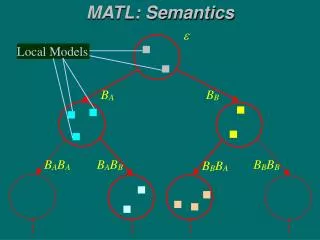
MATL: Semantics e Local Models BA BB BABA BABB BBBB BBBA . . . . . . . . . . . .
MATL: Semantics e BA BB BABA BABB BBBB BBBA Each viewa is associated with a set of local models (e.g. CTL structures) of the corresponding language La and a (local)satisfiability relation. . . . . . . . . . . . .
MATL: Semantics e ce BABBf BA BB cBA BBf BABA BABB BBBB BBBA f . . . . . . . . . . . .
MATL: Semantics e ce BABBf BA BB cBA BBf BABA BABB BBBB BBBA cBABB f . . . . . . . . . . . .
MATL: Semantics e ce BABBf BA BB cBA BBf BABA BABB BBBB BBBA cBABB f Achain clinks local models which assign the same truthvalue to formulae with the same intended meaning . . . . . . . . . . . .
Compatibility Chains Chainsarefinite sequences of local modelsof the form: c = <ce ,cBi,cBiBj ,…,ca > where • eachelementca is a local model of La • a = bg (i.e. b is a prefixof a)
Compatibility Chains Chainsarefinite sequences of local modelsof the form: c = <ce ,cBi,cBiBj ,…,ca > where • eachelementca is a local model of La • a = bg (i.e. b is a prefixof a) Chains can go through different modalities: express how different nested modalities affect each other.
Compatibility Chains e ce= ce BABBf BA cBA BBf BBf cBA
Compatibility Chains e ce= ce BABBf BA cBA BBf BBf cBA ACompatibility Relation Cis a set ofchainssuch that:ca Bfiffc C,ca=caimpliesca f
Chains and Satisfiability Given a Compatibility Relation C and a formula fLa, Ca :f (read f is true in C) is defined as follows: Ca:fiffc=<ce,cBi,cBiBj ,…,ca,…,cab>C,ca f
MATL: Semantics e Chains BA BB BABA BABB BBBB BBBA . . . . . . . . . . . .
MATL: Logical Consequence Definition: A set of MATL formulae Glogically entailsa:f G a : f if for every Compatibility Relation C and every chain cC: • if for every prefix b of a (i.e. a =bg for some g) cb Gb then ca f whereGb = {f | b:f belongs to G}
MATL Structure • We useCTL structureson thelanguagesof the correspondingviewsaslocal modelsof the views
MATL Structure • We use CTL structures on the languages of the corresponding views as local models of the views • Satisfiability in CTLis defined with respect to a CTL structure and a state. Therefor we take as local models pairs of the form < f , s > where • f = < S,J,R,L> is a CTL structure • s is a state of f (i.e. s belongs to S)
MATL Structure • We use pairs <CTL structure,state> as local models of each views • AMATL structure is a Compatibility Relation C such that: 1 for any chainc C, ca= < f , s > - where f = < S,J,R,L> is a CTL structure and - s is a state inS
MATL Structure • We use pairs <CTL structure,state> as local models of each views • AMATL structure is a Compatibility Relation C such that: 1 for any chainc C, ca= < f , s > - where f = < S,J,R,L>is a CTL structure and - s is a state inS 2for any statesofS , there isac Cwithca= < f , s >
MATL vs Modal Logic Under appropriate restrictions, MATL is “equivalent” to Modal Logic K (n).
MATL vs Modal Logic Under appropriate restrictions, MATL is “equivalent” to Modal Logic K(n). Restrictions: • Assume La=Lb for all views a,bB* • Assume each ais associated with the set of all the propositional models of La
MATL vs Modal Logic Theorem: For any formulae f,y Laand view aB* a: BX(f y) (BXf BXy)
MATL vs Modal Logic Theorem: For any formulae f,y Laand view aB* a: BX(f y) (BXf BXy) Theorem:For any view aB* and set of formulae G,fLa a : G a : f impliesa : BXG a : BXf (BXG = {BXy| yis a formula in G})
MATL vs Modal Logic Theorem: For any formulae f,y Laand view aB* a: BX(f y) (BXf BXy) Theorem: For any view aB* and set of formulae G,fLa a : G a : f impliesa : BXG a : BXf (BXG = {BXy| yis a formula in G}) Theorem:For any view aB* and set of formulae G,fLe e : G e : f iffa : G a : f
MATL vs Modal Logic Theorem: For any view aB* and formula f Le Kf iff a : f (where Kdenotes satisfiability in Modal K)