Characterization
Dive into the process by which writers reveal their characters' personalities, from analyzing characterization to making inferences and judgments. Explore the direct and indirect methods used to convey character traits. Learn to differentiate between credible and not credible, rounded and flat, stock and unique, as well as dynamic and static characters.

Characterization
E N D
Presentation Transcript
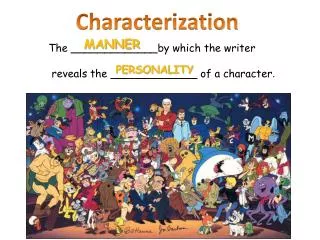
Characterization is… the process by which the writer reveals the personality of a character.
Analyzing Characterization Making judgments (or evaluations) about the character
INFERENCES Guesses made regarding a situation, using one’s understanding of context clues
DIRECT – tells the personality of the character Ex: “The patient boy and quiet girl both well-mannered and didn’t disobey their mother.”
INDIRECT – shows things that reveal character’s personality
S peech (what character says) T houghts (what character thinks) E ffect on others (how interacts with others) A ctions (what character does) L ooks (how character looks / dresses) INDIRECT (continued)
Credible Character is believable (could actually exist) Not Credible Character seems fake
Is the character believable? Would you expect to run into him or her in everyday life?
Rounded Character is complicated with multiple dimensions Flat Character only has a single trait
Does the character have multiple personality traits? Does he/she feel more than a single emotion?
Stock Character fits an exact stereotype; seems unoriginal Unique Character is unlike others
Is the character a stereotype? Is the character just one of many like him/her?
Dynamic Character undergoes some change and/or gains a new understanding Static Character stays the same