
SlideServe
Menu
Préférences
© SlideServe · v2026

Science of Interaction

ban avatar
9 diapositives · 423 Views · Sep 16, 2014

Science of Interaction. Thoughts on the Science of Interaction: Fundamental Changes Required In the Discourse for Discovery. Definition: visual analytics Why Interaction Must Change Ten Characteristics of New Science of Interaction. Jim Thomas
Science of Interaction - slide 1
01 / 9Science of Interaction
1 / 17

Télécharger la présentation

Science of Interaction
Une image / un lien ci-dessous est fourni (tel quel) pour télécharger la présentation

Politique de téléchargement : le contenu du site vous est fourni TEL QUEL pour votre information et votre usage personnel ; il ne peut être vendu, concédé sous licence ni partagé sur d’autres sites sans l’accord de son auteur.Le contenu vous est fourni TEL QUEL, pour votre information et votre usage personnel uniquement. Téléchargez la présentation en cliquant sur ce lien. Lors du téléchargement, si vous ne parvenez pas à télécharger une présentation, l’éditeur a peut-être supprimé le fichier de son serveur.Pendant le téléchargement, si vous ne parvenez pas à obtenir une présentation, le fichier a peut-être été supprimé par l’éditeur.

F I N

Plus de contenu associé

Transcription de la présentation
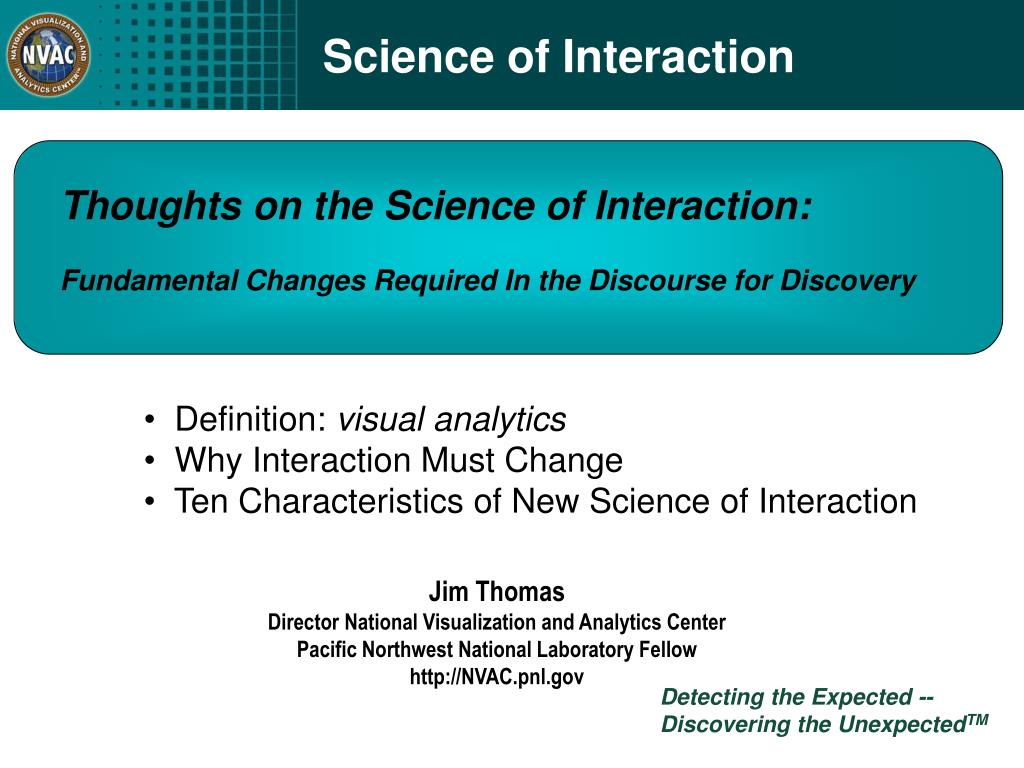
  1. Science of Interaction Thoughts on the Science of Interaction: Fundamental Changes Required In the Discourse for Discovery • Definition: visual analytics • Why Interaction Must Change • Ten Characteristics of New Science of Interaction Jim Thomas Director National Visualization and Analytics Center Pacific Northwest National Laboratory Fellow http://NVAC.pnl.gov Detecting the Expected -- Discovering the UnexpectedTM

  2. Visual Analytics Definition “Public”: Visual analytics provides the last 12 inches between the masses of information and the human mind to make decisions Science: Visual analytics is the science of analytical reasoning facilitated by interactive visual interfaces

  3. Why Interaction Must Change • Scale of Things to Come: • Information: • In 2002, recorded media and electronic information flows generated about 22 exabytes (1018) of information • In 2006, the amount of digital information created, captured, and replicated was 161 EB • In 2010, the amount of information added annually to the digital universe will be about 988 EB (almost 1 ZB)

  4. Why Interaction Must Change • Scale of Things to Come: • Information: • Drivers of Digital Universe: • 70% of the Universe is being produced by individuals • Organizations (businesses, agencies, governments, universities) produce 30% • Wal-Mart has a database of 0.5 PB; it captures 30,000,000 transactions/day • The growth is uneven • Today the United States accounts for 41% of the Universe; by 2010, the Asia Pacific region will be growing 40% faster than any of the other regions

  5. Why Interaction Must Change • Scale of Things to Come: • Information: • Drivers of Digital Universe: • Kinds of Data: • About 2 GB of digital information is being produced per person per year • 95% of the Digital Universe’s information is unstructured • 25% of the digital information produced by 2010 will be images • By 2010, the number of e-mailboxes will reach 2 billion • The users will send 28 trillion e-mails/year, totaling about 6 EB of data

  6. Why Interaction Must Change • Scale of Things to Come (info., drivers, kinds): • Today's interaction designed for point and click on individual items, groups(folders), and lists • Today's interaction assumes user knows subject, concepts within information spaces, and can articulate what they want • Today's interaction assumes data and interconnecting relationships are static in meaning over time • Today's interaction is one way initiated

  7. Ten Characteristics of New Science of Interaction:to start the conversation • New science of interaction enables two way: • Semantic: natural concept communication • Syntactic: likely mostly image, voice, augmented with selection and action methods • Multiscale interaction of discourse • Based on foundations of “critical thinking” • Enable predictive/proactive thinking • “Smart” agent based discourse • Assumptions, views, hypothesis, evidence, scenarios, all part of active and dynamic discourse • Public to expert analytics versions based on similar principals of interaction • Start very differently: get to know your data • Finish very differently: producing active product

  8. Science of Interaction Thoughts on the Science of Interaction: Fundamental Changes Required In the Discourse for Discovery “The old computing was about what computers could do; the new computing is about what users can do.” Ben Shneiderman, Leonardo’s Laptop Jim Thomas Director National Visualization and Analytics Center Pacific Northwest National Laboratory Fellow http://NVAC.pnl.gov Detecting the Expected -- Discovering the UnexpectedTM

  9. Reading • How Much Information? 2003 • UC Berkeley School of Information Management and Systems • The Expanding Digital Universe • A Forecast of Worldwide Information Growth Through 2010: IDC • Illuminating the Path: The R&D Agenda for Visual Analytics: http://nvac.pnl.gov • Critical Thinking: Foundations of Critical Thinking www.criticalthinking.org • Leonardo”s Laptop, Ben Shneiderman, MIT Press 2002