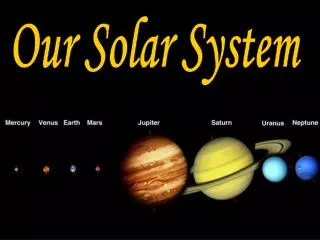
Exploring Our Solar System: Planetary Characteristics and Orbits
190 likes | 302 Vues
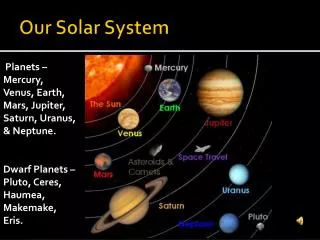
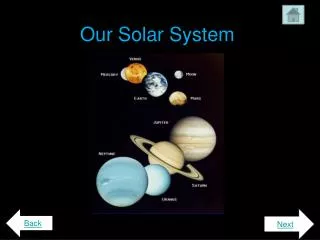
Discover the fascinating details of our solar system, including the time planets take to orbit the Sun and their unique characteristics. Learn about Mercury, the smallest and fastest planet; Venus, known for its intense heat; Earth, the only planet known to support life; and Mars, the red planet once believed to have had water. Dive into the gas giants, including Jupiter with its Great Red Spot, Saturn's stunning rings, Uranus's sideways spin, and Neptune's deep blue hue. Join us on a journey through space!


Exploring Our Solar System: Planetary Characteristics and Orbits
E N D
Presentation Transcript
Year The time it takes a planet to make one trip around the Sun http://mistupid.com/astronomy/orbits.htm Day The time it takes a planet to spin around one time on its axis
Terrestrial A planet made of rock; it means rocky or Earth-like Gas Giant A planet made of gases with a small rocky core
Mercury The smallest planet Named for roman messenger because it moves so fast around the Sun
Very thin atmosphere • Closest to the sun • Temperature: 800º F • Year: 87 Earth days • Day: 178 Earth days • Diameter: 4,880 km
Venus The hottest planet Named for the ancient god of beauty because it is so bright in night sky
Intense heat and crushing pressure • About the same size as Earth • Temperature: 896º F • Year: 246 Earth days • Day: 243 Earth days • Diameter: 12,104 km
Earth Our home planet The only planet not named for an ancient god
The most unique planet • Only planet capable of life • Temperature: 100º F • Year: 365.25 Earth days • Day: 24 Earth hours • Diameter: 12,756 km
Mars The red planet Named for ancient god of war because of its reddish look
May have once had water and life • Home of Olympus Mons, largest volcano in solar system • Temperature: -81º F • Year: 710 Earth days • Day: 24.6 Earth hours • Diameter: 6,794 km
Jupiter Home of the Great Red Spot Named for the king of the gods because of its size
Red Spot: giant hurricane larger than Earth • Strong winds give it a banded look • Temperature: -101º F • Year: 12 Earth years • Day: 10 Earth hours • Diameter: 143,000 km
Saturn The ringed planet Named for ancient god of agriculture because of when it is seen in the night sky
Has the most complex ring system • Strong winds give it a banded look • Temperature: -274º F • Year: 29 Earth years • Day: 11 Earth hours • Diameter: 120,500 km
Uranus Spins on its side Named for ancient god of the heavens because of bright green color
Has a ring system • Chemicals give it a green look • Temperature: -328º F • Year: 84 Earth years • Day: 18 Earth hours • Diameter: 51,120 km
Neptune The blue planet Named for ancient god of the sea because of its blue look
Home of Great Blue Spot; Giant hurricane system • Chemicals give it a blue look • Temperature: -346º F • Year: 165 Earth years • Day: 17 Earth hours • Diameter: 49,530 km