Understanding Energy: Transformations, Conservation, and Measurements
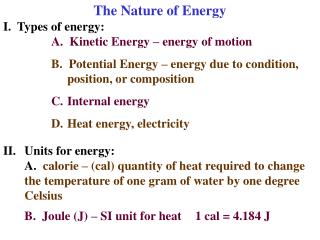
This guide explores the concept of energy, defining it as a feeling of power and the ability to cause change. It explains energy transformations, highlighting how the sun creates energy and how one form of energy converts into another. Essential concepts include the law of conservation of energy, which states energy cannot be created or destroyed, only transformed. The document covers energy measurement in joules, relations of potential and kinetic energy in various contexts, such as a ballet dancer and combustion engines, emphasizing the importance of energy conservation.

Understanding Energy: Transformations, Conservation, and Measurements
E N D
Presentation Transcript
WEEK 13SKIP A PAGE IN YOUR CRCT NOTEBOOK What is energy? A feeling of power The ability to cause change A change in the amount of motion Anything that flows out of one thing into another
2. What happens in an energy transformation? • The Sun creates energy • Energy causes a physical object to move • One form of energy changes into another form of energy • Some energy is permanently used up
3. When energy is converted from one form to another, what is usually produced? • heat • chemical energy • electromagnetism • gravity
4. The law of conservation of energy states that • we should conserve energy resources whenever possible. • energy conserves power in closed systems. • the energy that reaches Earth is mostly absorbed by the surface. • energy is neither created or destroyed, it can just be transformed (change forms).
5. The joule is a unit for measuring energy. According to the law of conservation of energy, if 30 joules of EM energy is converted to sound and heat, how much of the energy will be permanently lost? • all 30 joules. • about half-15 joules • it depends on the efficiency of the transformation • none of the energy
6.The amount of energy an object has it related to its • temperature. • mass. • velocity. • distance.
7. Potential energy, either from position or chemical composition, is • concentrated • small compared to kinetic energy • stored. • quickly used up.
8. Kinetic energy increases with increasing • chemical reactions. • distance. • volume. • speed.
9. A ballet dancer balances on one pointed toe shoes. What is the relationship of potential and kinetic energy in the ballerina? • The are available in equal quantities. • The dancer has more potential energy than kinetic energy at this moment. • The dancer has more kinetic energy than potential energy at this moment. • Kinetic energy can be released and transformed into potential energy immediately.
10. Most cars have internal combustion engines. In these engines, a spark ignites fuel, and the resulting reaction forces pistons to move. The fuel in the car has • potential energy due to gravity. • kinetic energy due to chemical composition. • potential energy due to chemical composition. • kinetic energy due to gravity.