Download
1 / 20
200 likes | 326 Vues
Explore the two predominant models of our solar system: the Geocentric model, which places Earth at the center with celestial bodies, including the sun and stars, revolving around it, and the Heliocentric model, where the Earth rotates on its axis and revolves around the sun. Learn about Kepler's Laws of planetary motion, including eccentricity, perihelion, and aphelion, and how the Earth's slightly elliptical orbit influences the speed of its revolution. Delve into the gravitational dynamics that shape our celestial neighborhood.

E N D
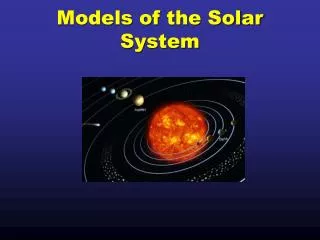
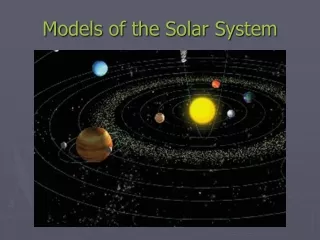
Models of the Solar System 2 Theories
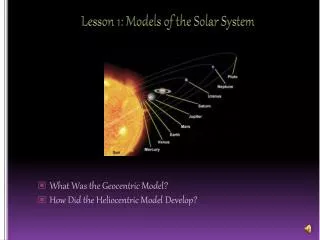
Geocentric Model • System of objects revolving around the Earth…including the sun and stars
Heliocentric Model Earth rotates on an imaginary axis and revolves around the sun in an orbit.
First Law-The Earth travels in an ellipse around the sun • The Sun is at one of the foci.
Perihelion • The position when Earth is closest to the sun. • Occurs around January 3
Aphelion • The position when Earth is furthest from the sun. • Occurs around July 3.
Eccentricity • measure of how much the ellipse deviates from a circle. (how elliptical) • E = distance between foci/length of the major axis (d/l)
Eccentricity of a circle is 0 • Eccentricity of a line 1 • The Earth’s orbit is SLIGHTLY elliptical 0.017 (not very elliptical)
Second Law- • Orbital Velocity- The speed of the planets as they travel around the sun. • Earth – about 1°/day • Velocity will change due to changes is gravitational pull
At Perihelion – velocity slightly increases • At Aphelion- Velocity slightly decreases
Third Law • The further the planet is from the sun, the longer the period of revolution