
Solar System
E N D
Presentation Transcript
Solar System (Student Presentation)
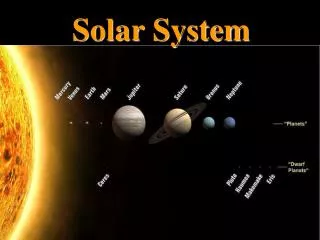
Sun • The center of the solar system. • It contains more than 99.8% of the total mass of the Solar System. • about 70% hydrogen and 28% helium. • Layer of the sun: • Photosphere • Chromospheres
MERCURY • Mercury is the closest planet to the Sun • The eighth largest. • Mercury is slightly smaller in diameter than the moons Ganymede and Titan but more than twice as massive. • orbit: 57,910,000 km • diameter: 4,880 km mass: 3.30e23 kg
VENUS • Venus is the second planet from the Sun and the sixth largest. • Venus' orbit is the most nearly circular of that of any planet, with an eccentricity of less than 1%. • orbit: 108,200,000 km • diameter: 12,103.6 km • mass: 4.869e24 kg
EARTH • Earth is the third planet from the Sun • The fifth largest. • Orbit: 149,600,000 km • Diameter: 12,756.3 km • Mass: 5.972,24 kg • The only planet that can sustain life. • The Moon is the only natural satellite of Earth.
MARS • Mars is the fourth planet from the Sun • The seventh largest: • Orbit: 227,940,000 km • Diameter: 6,794 km • Mass: 6.4219,23 kg
JUPITER • Jupiter is the fifth planet from the Sun and by far the largest. Jupiter is more than twice as massive as all the other planets combined (318 times Earth). • Orbit: 778,330,000 km • Diameter: 142,984 km (equatorial) • Mass: 1.900e27 kg
SATURN • Saturn is the sixth planet from the Sun • The second largest planet • Orbit: 1,429,400,000 km • Diameter: 120,536 km (equatorial) • Mass: 5.68e26 kg
NEPTUNE • Neptune is the eighth planet from the Sun • The fourth largest (by diameter). • Neptune is smaller in diameter but larger in mass than Uranus. • Orbit: 4,504,000,000 km Sun • Diameter: 49,532 km (equatorial) • Mass: 1.0247e26 kg
URANUS • Uranus is the seventh planet from the Sun • The third largest (by diameter). • Uranus is larger in diameter but smaller in mass than Neptune. • Orbit: 2,870,990,000 km Sun • Diameter: 51,118 km (equatorial) • Mass: 8.683e25 kg
PLUTO • Pluto is the farthest planet from the Sun • by far the smallest planet. • Pluto is smaller than seven of the solar system's moons (the Moon, Io, Europa, Ganymede, Callisto, Titan and Triton). • Orbit: 5,913,520,000 km • Diameter: 2274 km • Mass: 1.27e22 kg
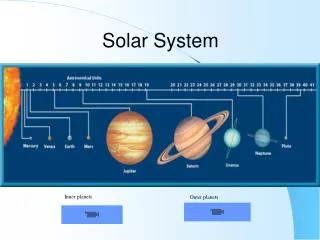
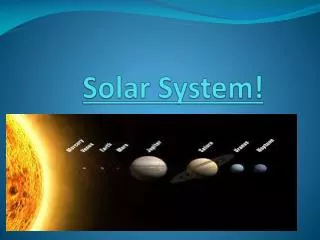
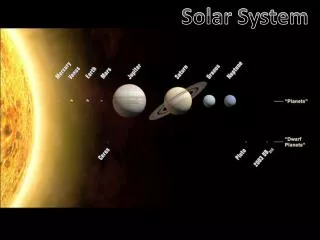
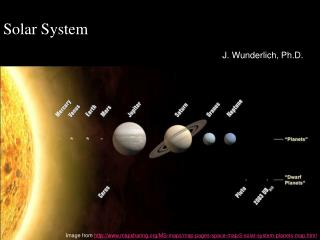
Terrestrial Planets Mercury Venus Earth Mars Jovian Planets Jupiter Saturn Neptune Uranus Pluto is not a terrestrial nor a jovial planet. The Nine Planets are:
Concept Map Sun Terrestrial Planets Jovian Planets mercury Jupiter Saturn Venus Neptune Uranus Earth Mars ●Pluto can be terrestrial and Jovian Planet