Download
1 / 21
210 likes | 319 Vues
This study explores the intricacies of galactic chemical evolution, focusing on stellar nucleosynthesis processes, specifically stellar yields and their statistical analysis. We aim to establish a chronology of metallicity events, assessing how various stellar sources (e.g., SNIa, AGB) contribute to isotope abundances. The investigation of gas inflow and star formation rates in the solar neighborhood aids in understanding the age-metallicity relationship. Additionally, we examine how the Milky Way's abundance gradients are shaped over time, particularly for elements like carbon, nitrogen, and oxygen.

E N D
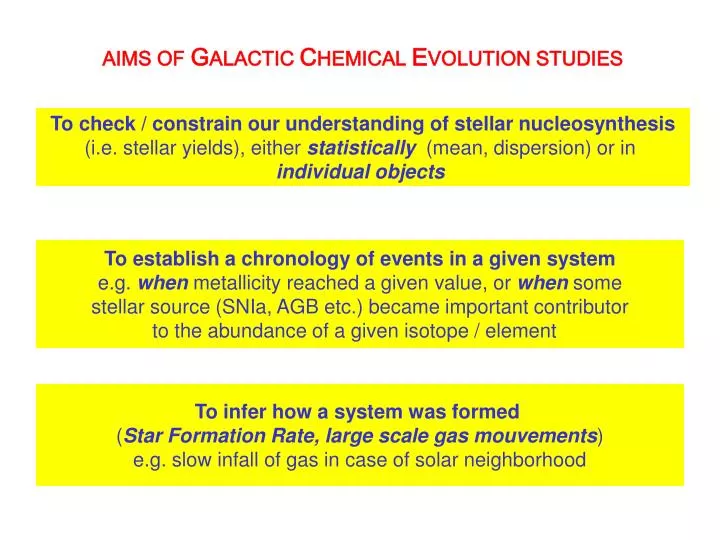
AIMS OF GALACTIC CHEMICAL EVOLUTION STUDIES To check / constrain our understanding of stellar nucleosynthesis (i.e. stellar yields), either statistically (mean, dispersion) or in individual objects To establish a chronology of events in a given system e.g. when metallicity reached a given value, or when some stellar source (SNIa, AGB etc.) became important contributor to the abundance of a given isotope / element To infer how a system was formed (Star Formation Rate, large scale gas mouvements) e.g. slow infall of gas in case of solar neighborhood
THE SOLAR NEIGHBORHOOD AGE-METALLICITY METALLICITY DISTRIBUTION SLOW INFALL ( = 7 Gyr) to fix G-dwarf problem, SNIa to account for [Fe/O] evolution PREDICTIONS: D evolution, evolution of abundances (depends on yields)
Woosley and Weaver 1995, Overproduction factors of elements in massive stars
ABUNDANCES AT SOLAR SYSTEM FORMATION (Massive stars: Woosley+Weaver 1995; Intermediate mass stars: van den Hoek+Gronewegen 1997; SNIa: Iwamoto et al. 2000)
AGES OF GLOBULAR CLUSTERS Salaris and Weiss 2002 AGES OF HALO STARS Marquez and Schuster 1994
OUTFLOW INFALL
Stars of mass M > 2 Mʘ (Lifetime < 1 Gyr) enriched the Galaxy during the halo phase AGE – METALLICITY IN THE GALACTIC HALO Note: Instantaneous mixing approximation probably invalid at early times
NOTE: PRIMARIESVSSECONDARIES 1) CHEMICAL EVOLUTION (yield: IMF integrated or individual stars) PRIMARY: yield yP independent of Z SECONDARY: yield yS proportional to Z 2) STELLAR NUCLEOSYNTHESIS (yield from individual stars) PRIMARY: from H, He and their products (C,O) (yield not necessarily Z independent!) SECONDARY: from some metal at stellar formation (yield not necessarily proportional to Z!)
STELLAR CNO YIELDS MASSIVE STARS(107years): Secondary Non Rotating: INTERMEDIATE MASS (108years): Primary LOW MASS STARS (109 years): Secondary NITROGEN PRODUCTION Rotating:MASSIVE STARS(107years): Secondary StarsINTERMEDIATE AND LOW MASS (108years): Primary
EVOLUTION OF CNO IN SOLAR NEIGHBORHOOD C and N abundances always follow Fe PRIMARIES ? But:2/3 of Fe in disk come late from SNIa ⇩ 2/3 of C and N in disk come from a late source (not operating in halo) Low mass stars ? Secondary N (but C?) Z-dependent yields from massive stars? No sign of secondary N in early halo: Which primary source?
Secondary N production at late times matches Fe production from SNIa [N/Fe] 0 Not exactly the case for C… Stellar rotation has similar effect on yields of nitrogen (mostly from Intermediate mass stars) as Hot Bottom Burning • Difficult to explain earliest primary Nitrogen • (Massive star yields insufficient • even with rotation…) • However: timescales at low [Fe/H] uncertain!
FRACTIONAL CONTRIBUTION TO CARBON-12 PRODUCTION FRACTIONAL CONTRIBUTION TO NITROGEN-14 PRODUCTION
WW95 + VdHG97 MM02 No Rot MM02 + Rot PRIMARY NITROGEN… WITH RESPECT TO WHAT ??? PSEUDO-SECONDARY BEHAVIOUR WITH RESPECT TO OXYGEN
THE MILKY WAY DISK Inside-Out formation and radially varying SFR efficiency required to reproduce observed SFR, gas and colour profiles (Scalelengths:RB4 kpc, RK2.6 kpc) (Boissier and Prantzos 1999)
METALLICITY PROFILE OF MILKY WAY DISK Present day gradient : dlog(O/H)/dR ∼ - 0.07 dex/kpc Models predict (e.g. Hou et al. 2000) that abundance gradients were steeper in the past
METALLICITY PROFILE OF MILKY WAY DISK “Observed” evolution of O gradient: d[dlog(O/H)/dR]/dt ∼ 0.004 dex/kpc/Gyr In broad agreement with theory Recent observations (Maciel et al 2002) of planetary nebulae of various ages support that prediction: The disk was formed inside-out
ABUNDANCE GRADIENTS OF CNO IN MILKY WAY DISK O: dlog(O/H) / dR = - 0.07 dex/kpc But: Deharveng et al. (2001): -0.04dex/kpc N: dlog(N/H) / dR = - 0.08 dex/kpc C: dlog(C/H) / dR = - 0.07 dex/kpc
ABUNDANCE GRADIENTS OF CNO IN MILKY WAY DISK C and O not sensitive to different sets of yields (primaries) For N, stellar yields up to Z=3 Z⊙ (not available at present) are required in order to model the inner disk