
SlideServe
Menu
Préférences
© SlideServe · v2026

Data Definition Language (DDL)

bayle avatar
9 diapositives · 1.9K Views · Aug 22, 2014

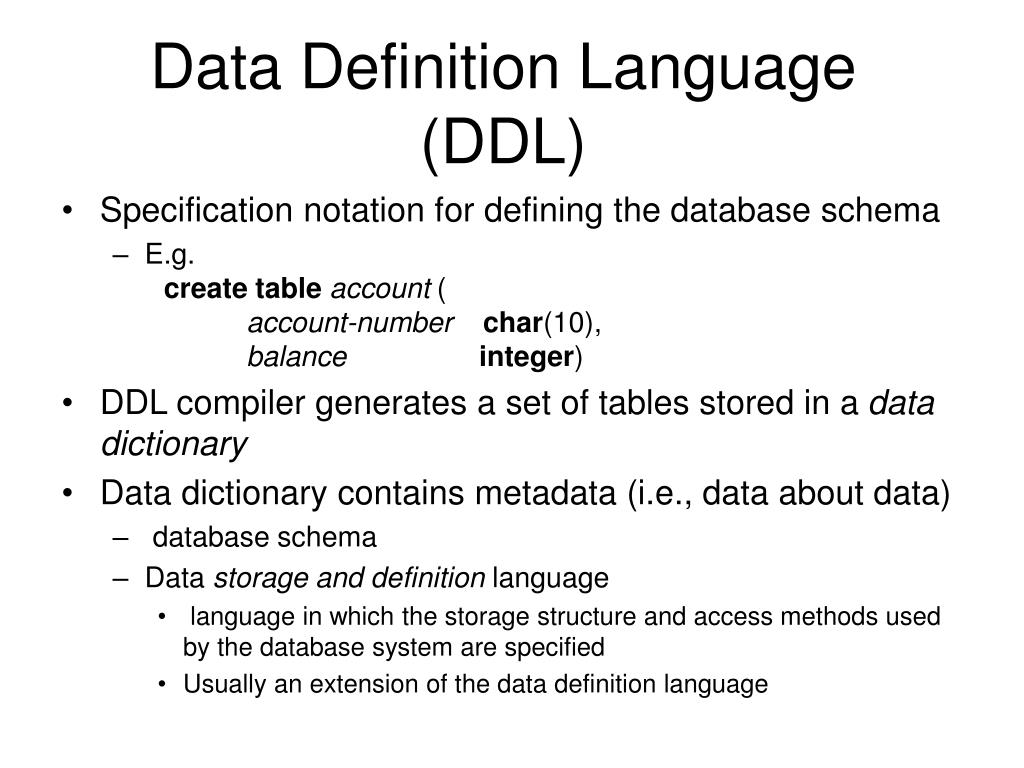
Data Definition Language (DDL). Specification notation for defining the database schema E.g. create table account ( account-number char (10), balance integer ) DDL compiler generates a set of tables stored in a data dictionary Data dictionary contains metadata (i.e., data about data)
Data Definition Language (DDL) - slide 1
01 / 9Data Definition Language (DDL)
1 / 17

Télécharger la présentation

Data Definition Language (DDL)
Une image / un lien ci-dessous est fourni (tel quel) pour télécharger la présentation

Politique de téléchargement : le contenu du site vous est fourni TEL QUEL pour votre information et votre usage personnel ; il ne peut être vendu, concédé sous licence ni partagé sur d’autres sites sans l’accord de son auteur.Le contenu vous est fourni TEL QUEL, pour votre information et votre usage personnel uniquement. Téléchargez la présentation en cliquant sur ce lien. Lors du téléchargement, si vous ne parvenez pas à télécharger une présentation, l’éditeur a peut-être supprimé le fichier de son serveur.Pendant le téléchargement, si vous ne parvenez pas à obtenir une présentation, le fichier a peut-être été supprimé par l’éditeur.

F I N

Plus de contenu associé

Transcription de la présentation
  1. Data Definition Language (DDL) • Specification notation for defining the database schema • E.g. create tableaccount (account-numberchar(10),balanceinteger) • DDL compiler generates a set of tables stored in a data dictionary • Data dictionary contains metadata (i.e., data about data) • database schema • Data storage and definition language • language in which the storage structure and access methods used by the database system are specified • Usually an extension of the data definition language

  2. Data Manipulation Language (DML) • Language for accessing and manipulating the data organized by the appropriate data model • DML also known as query language • Two classes of languages • Procedural – user specifies what data is required and how to get those data • Nonprocedural – user specifies what data is required without specifying how to get those data • SQL is the most widely used query language

  3. SQL • SQL: widely used non-procedural language • E.g. find the name of the customer with customer-id 192-83-7465selectcustomer.customer-namefromcustomerwherecustomer.customer-id = ‘192-83-7465’ • E.g. find the balances of all accounts held by the customer with customer-id 192-83-7465selectaccount.balancefromdepositor, accountwheredepositor.customer-id = ‘192-83-7465’ anddepositor.account-number = account.account-number • Application programs generally access databases through one of • Language extensions to allow embedded SQL • Application program interface (e.g. ODBC/JDBC) which allow SQL queries to be sent to a database

  4. Database Users • Users are differentiated by the way they expect to interact with the system • Application programmers – interact with system through DML calls • Sophisticated users – form requests in a database query language • Specialized users – write specialized database applications that do not fit into the traditional data processing framework • Naïve users – invoke one of the permanent application programs that have been written previously • E.g. people accessing database over the web, bank tellers, clerical staff

  5. Database Administrator • Coordinates all the activities of the database system; the database administrator has a good understanding of the enterprise’s information resources and needs. • Database administrator's duties include: • Schema definition • Storage structure and access method definition • Schema and physical organization modification • Granting user authority to access the database • Specifying integrity constraints • Acting as liaison with users • Monitoring performance and responding to changes in requirements

  6. Transaction Management • A transaction is a collection of operations that performs a single logical function in a database application • Transaction-management component ensures that the database remains in a consistent (correct) state despite system failures (e.g., power failures and operating system crashes) and transaction failures. • Concurrency-control manager controls the interaction among the concurrent transactions, to ensure the consistency of the database.

  7. Storage Management • Storage manager is a program module that provides the interface between the low-level data stored in the database and the application programs and queries submitted to the system. • The storage manager is responsible to the following tasks: • interaction with the file manager • efficient storing, retrieving and updating of data

  8. Overall System Structure

  9. Application Architectures • Two-tier architecture: E.g. client programs using ODBC/JDBC to communicate with a database • Three-tier architecture: E.g. web-based applications, and applications built using “middleware”