EE104: Lecture 22 Outline
80 likes | 210 Vues
This lecture covers essential concepts of Frequency Modulation (FM), focusing on spectral analysis, bandwidth calculations using Carson's Rule, and modulation strategies for Narrowband and Wideband FM. Key topics include FM detection methods, superheterodyne receivers, and the robustness of FM signals to amplitude variations and reflections. The presented material is foundational for understanding FM systems in communication, with practical insights on signal generation and demodulation techniques. Important announcements regarding homework and upcoming final exams are also included.


EE104: Lecture 22 Outline
E N D
Presentation Transcript
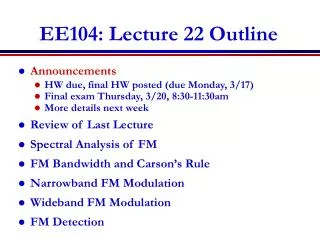
EE104: Lecture 22 Outline • Announcements • HW due, final HW posted (due Monday, 3/17) • Final exam Thursday, 3/20, 8:30-11:30am • More details next week • Review of Last Lecture • Spectral Analysis of FM • FM Bandwidth and Carson’s Rule • Narrowband FM Modulation • Wideband FM Modulation • FM Detection
Review of Last Lecture • Vestigial Sideband Modulation • Transmits a small part of unwanted sideband • Does not cause distortion at baseband • Can use a carrier or suppress the carrier • Standard envelope detection or DSBSC demod. • AM Radio • Superheterodyne Receivers • Use IF downconversion and processing • Gets around reradiation and processing at fc. • Introduction to FM
Introduction to FM • Information signal encoded in carrier frequency (or phase): s(t)=Accos(q(t)) • q(t)=f(m(t)) • Standard FM: q(t)=2pfct+2pkf m(t)dt • Signal robust to amplitude variations • Robust to signal reflections and refractions • Instantaneous frequency: fi=fc+kfm(t) • Maximum Deviation:Df=fc+kf|m(t)| • Bandwidth of S(f) depends on Df.
B2Df WBFM B2Bm NBFM Spectral Analysis of FM • s(t)=Accos(2pfct+2pkf m(t)dt) • Nonlinear function of m(t) • Very hard to analyze for general m(t). • Let m(t)=cos(2pfmt): Bandwidth fm • Spectrum S(f) is a sequence of delta functions at multiples of fm from fc S(f) for m(t)=cos(2pfmt) … … f fc -4fm fc+fm fc -3fm fc+3fm fc fc -2fm fc+2fm fc+ 4fm fc-fm
FM Bandwidth and Carson’s Rule • Frequency Deviation: Df=kf max|m(t)| • Maximum deviation of fi from fc: fi=fc+kfm(t) • Carson’s Rule: • B depends on maximum deviation from fcAND how fast fi changes • Narrowband FM: Df<<BmB2Bm • Wideband FM: Df>>BmB2Df B2Df+2Bm
Generating FM Signals • NBFM • WBFM • Direct Method: Modulate a VCO with m(t) • Indirect Method: Use a NBFM modulator, followed by a nonlinear device and BPF f(t) s(t) m(t) - Product Modulator 2pkf(·)dt + + Accos(2pfct) Acsin(2pfct) LO -90o
FM Detection • Differentiator and Envelope Detector • Zero Crossing Detector • Uses rate of zero crossings to estimate fi • Phase Lock Loop (PLL) • Uses VCO and feedback to extract m(t)
Main Points • Spectral analysis of FM difficult. For a simple cosine information signal, FM spectrum is discrete and infinite. • FM signal bandwidth depends on information signal amplitude. Carson’s rule yields B=2Bm+2Df. • NBFM easy to analyze and is generated with a simple product modulator. WBFM harder to generate and to analyze. • In theory just need a differentiator and envelope detector for FM demodulation. Multiple methods used in practice