Expansionism
Expansionism is the drive of a nation-state or large organization to extend its influence and power. Historically, this desire led European powers to establish vast empires by the eve of World War I, controlling over one-third of the world's land. Although military expansion has declined since World War II, cultural, religious, and business expansion continue. Globalization has enabled the spread of culture, while transnational corporations wield immense economic power. Understanding these dimensions is crucial to interpreting modern international relations and the legacies of past empires.
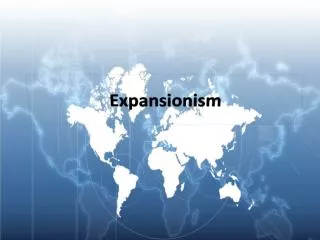

Expansionism
E N D
Presentation Transcript
Expansionism is the desire for a nation-state or large organisation to increase its power to the furthest limit. This can include: • Military • Cultural • Religious • Business
Military This allowed the European powers to form large empires over the globe. On the eve of WW1 five European nations ruled over 1/3 of the worlds surface This still has its legacy in the current world order Since WW2 there has been a decline in the formation of empires through military means.
Cultural Nations can impose their way of life and beliefs on others through distribution of their culture. Advent of globalisation and technology have made this more achievable. USA is the dominant power in this through their influence in pop culture mediums. Can be referred to as ‘Pax Americana’
Religious Religions have been exported to different parts of the globe through history. Empires have been built using religion as a pretence and for waging wars. Used to make native populations less hostile Missionaries in Asia and Europe were often brutal in their treatment of Indigenous populations. Current extremism is causing international instability
Business Globalisation has given rise to the Trans-National Corporation (TNC) Some companies have bigger profits than most nations Over 40000 companies operate across borders Can operate as a law unto themself Need to strengthen int’l law to regulate these companies activities Can exploit social inequality and injustice by taking advantage of those in weak positions. The IMF and World Bank can also be seen to influence how nations develop and interact