Rain Rates Measured Acoustically Using Passive Aquatic Listener
70 likes | 166 Vues
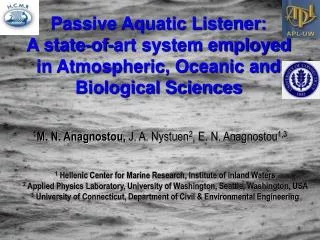
This presentation discusses the innovative use of passive acoustic monitoring to measure rainfall rates and wind speeds in oceanic environments. Collaborating with experts from the University of Washington's Applied Physics Laboratory, the research utilizing Argo floats and passive aquatic listeners demonstrates significant findings from the SPURS region in the Equatorial Pacific. Initial comparisons to central mooring and satellite data show promising correlations in climatology, reinforcing the viability of this technology for long-term ocean monitoring.


Rain Rates Measured Acoustically Using Passive Aquatic Listener
E N D
Presentation Transcript
Rain Rates Measured Acoustically Using Passive Aquatic Listener Jie Yang, William E. Asher, Jeffrey A. Nystuen, and Andrew T. Jessup Applied Physics Laboratory, University of Washington Acoustics Department talk, April 7, 2014
Argo floats (collaboration with Steve Riser) PAL for moorings • Adaptive underwater recorder • Very low power consumption • High bandwidth (1-40 kHz) • Park depth – 2000 m Park depth – 1000 m Profile duration – several days Expected lifetime – several years Iridium communication – 2-way
200 km 220 km Float trajectories during SPURS (Thanks to Jessica Anderson for the figure) Float 7587
Comparison of wind speed between PAL and central mooring Float 7587
Comparison of accumulated rain amount Float 6923 Float 7681 Float 7587
Summary • Passive acoustic monitoring of the ocean can provide measurements of wind speed and rainfall rate • Passive acoustic monitoring technology has been deployed on STS/PAL floats • Initial results from five STS/PAL floats (SPURS region, Equatorial Pacific, and Bay of Bengal) show wind speed and rainfall climatology • Acoustically derived wind speed compares very well with central mooring MET data • Comparison between acoustically derived rainfall accumulation using the twelve SPURS STS/PAL floats with satellite data is very encouraging