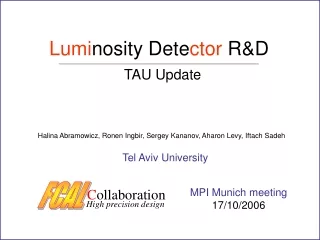
Status Update on Large and Small Panel Signal Performance and Efficiency Tests
The large panel (VP1) is operational, producing fast and clean signals with consistent behavior across HV channels. Initial radiation response measurements with electrons and muons have been completed. Testing on the small panel (BN01) confirmed vacuum integrity, with signal tests slated for tomorrow. A hodoscope with an active area of ~2.5 cm² detected 1509 cosmic triggers over 13 hours. Voltage scans and adjustments revealed issues with grounding and signal consistency. Future plans include continued signal shape studies and efficiency evaluations of both panels.


Status Update on Large and Small Panel Signal Performance and Efficiency Tests
E N D
Presentation Transcript
TAU - status August 17
Status • Large panel (VP1) is working and producing fast clean signals. • With 1, 2 or 4 HV channels signals look and behave exactly the same. • First measurements of response to radiation – both electrons and muons. • Small panel (BN01) was tested and found to hold vacuum, should be tested for signals tomorrow.
Our hodoscope • Roughly 2.5 cm2 of active area. • Overnight measurement of 13hours beneath the panel give 1509 cosmic triggers • This corresponds to ~2muons per minute
Signal shape study (VP1) set-up • Quench resistors: 20 Mohm (per line) • 4 RO lines: voltage divider (100:1 Ohm) • MDT gas (Ar-CO2 93%-7%) 600 Torr • RO lines connected to scope 1 Ohm Ni – RO line 100 Ohm For each RO line
Efficiency tests Set-up Source Panel Hodoscope AND between the scintillators OR between the RO lines AND counter counter counter • Quench resistors: 20 Mohm(per line) • 4 RO lines: voltage divider (100:1 Ohm) • Every RO line into discriminator -> logic
First attempt – Voltage scan, MDT gas @600Torr • More triggers as Voltage rises!!! • -> BAD grounding
Adjustments • Every ground in the system was connected to the other grounds with a thick wire. • Coincidents between panel & trigger almost stopped • We raised the voltage without improvement • White discoloration of the active pixels is visible. • Gas was changed to the same gas type and pressure. • New working area in the panel. • Hodoscope was raised closer to the panel
Second attempt – Voltage scan, MDT gas @600Torr • Trigger is constant regardless to panel Voltage • Almost no coincident between trigger and signal
Background • Without the source sitting on the panel there is almost no background. • No coincident between signal and the trigger At all
Efficiency tests Set-up 2 Source Panel Hodoscope AND between the scintillators OR between the RO lines AND counter counter counter • Quench resistors: 20 Mohm(per line) • 4 RO lines: voltage divider (100:1 Ohm) • Every RO line into discriminator -> logic
Third attempt – Voltage scan, MDT gas @600Torr • Rate of upper scintillation counter is ~15KHz • Rate of trigger is ~25 • We believe that upper scintillation pad is at it’s rate limit
Plans for next week • Signal shape studies with BN01 panel • Rates study - continue with PV1, start with BN01 panel • Expand the study to CF4