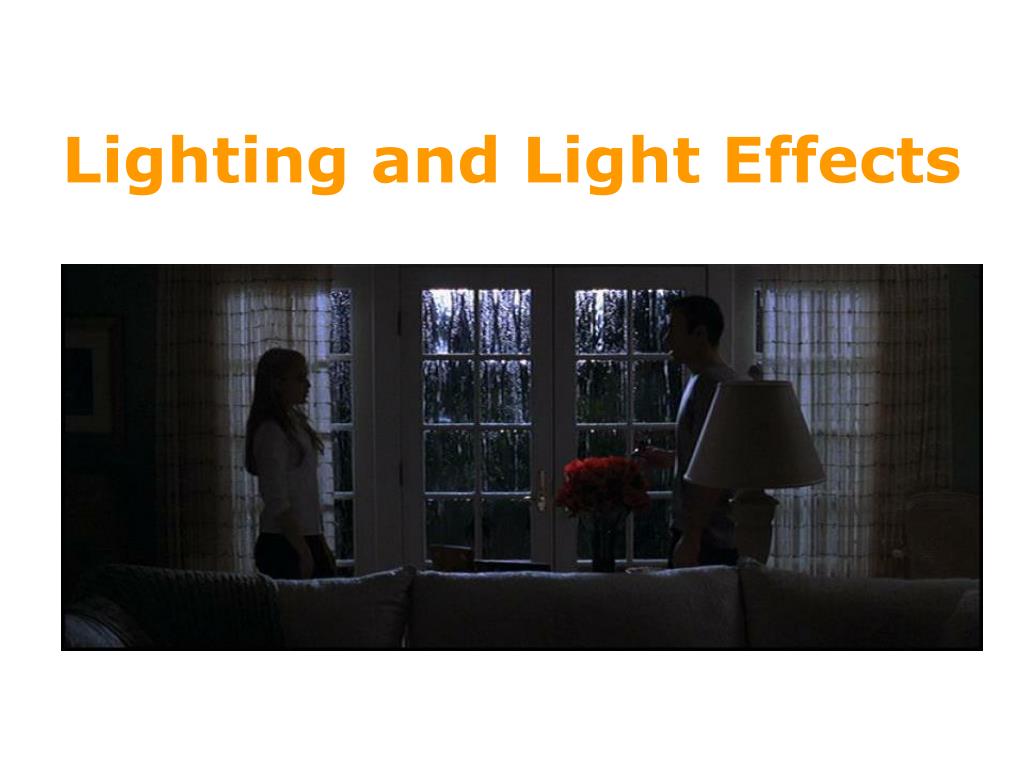
Lighting and Light Effects. Whether natural or artificial light is used in making a film, it has a big influence on the look and mood that is created. Natural light can vary from bright, clear and sunny. Richard Farnsworth in The Straight Story (1999).
Une image / un lien ci-dessous est fourni (tel quel) pour télécharger la présentation
Politique de téléchargement : le contenu du site vous est fourni TEL QUEL pour votre information et votre usage personnel ; il ne peut être vendu, concédé sous licence ni partagé sur d’autres sites sans l’accord de son auteur.Le contenu vous est fourni TEL QUEL, pour votre information et votre usage personnel uniquement.Téléchargez la présentation en cliquant sur ce lien.Lors du téléchargement, si vous ne parvenez pas à télécharger une présentation, l’éditeur a peut-être supprimé le fichier de son serveur.Pendant le téléchargement, si vous ne parvenez pas à obtenir une présentation, le fichier a peut-être été supprimé par l’éditeur.
Whether natural or artificial light is used in making a film, it has a big influence on the look and mood that is created. • Natural light can vary from bright, clear and sunny Richard Farnsworth in The Straight Story (1999)
to the pouring rain… … the skies weeping as the political prisoners are brought to the detention centre that only one will leave alive, in V for Vendetta.
to the drama of storm in Moulin Rouge Here the storm is more than just bad weather; it is also a metaphor for the troubles facing the hero and heroine.
high-key lighting • indicates a brightly lit scene with few shadows; usually provided by one source of light (the 'key light'). Michael Sheen in The Queen
low-key lighting • is where the lighting is more towards the greyer and darker scale, where there is a good deal of shadow, and where the key light is less bright and does not dominate. Jim Carrey in Eternal Sunshine of the Spotless Mind
'high-contrast' lighting • is where there is strong contrast between bright light and shadow, with a small amount of in-between grey scale Nicole Kidman in Moulin Rouge
Light can be either hard or soft light. • hard light clearly illuminates areas, sharply outlines and illuminates characters, brings out detail and texture, and markedly separates light and shadows • soft light covers a wider area with a more diffuse light, diminishes outline and clarity of characters, minimises shadow, and reduces modelling of detail and texture.
Soft light tends to hide surface irregularities and detail, so the the surface carving is barely noticeable • Hard light gives a hard, crisp, sharply defined appearance, and casts a sharp, clearly defined shadow. • Sources include the light from a clear, unfrosted light bulb, a focused spotlight, or the noonday sun in a clear sky.
Three-point lighting is the standard method used in visual media such as film, still photography and computer-generated imagery. • It is a simple but versatile system which forms the basis of most lighting. • Once you understand three-point lighting, you are well on the way to understanding all lighting.
key light • This is the main light. subject • It is usually the strongest and has the most influence on the look of the scene. camera • The key light is placed to one side of the camera/subject so that this side is well lit and the other has some shadow. • It provides hard light, like that from the sun on a clear day: a bright light with hard-edged shadows. • It provides excellent modelling by highlighting the shape and contours of the subject.
fill light • This is the secondary light and is placed on the opposite side to the key light. • Its light can be likened to indirect sunlight or reflected light from the environment. • It is used to fill the shadows created by the key. The fill will usually be softer and less bright than the key and casts soft indistinct shadows. • It is sometimes referred to as the 'highlight' as it is often used to give a sheen or highlight to an actor's hair.
back light • The back light is placed behind the subject and lights it from the rear. • Rather than providing direct lighting (which the key and fill give), its purpose is purely for modelling – to provide definition and subtle highlights around the subject's outlines. • This helps separate the subject from the background and give a three-dimensional look.
illustrating lighting • The following images of a computer-generated apple are from an online lighting tutorial. • key light only • the key light has been placed to the right of the camera and has created very sharp shadows. • It looks okay – is identifiably an apple – but doesn't show any real depth.
fill light only • The fill light is usually on the opposite side of the camera from the key, so in this case it is on the left. • As it should be a soft light (created by use of filters or diffusers) the effect is similar to the key except the shadows are less defined. The apple looks flat and artificial.
key + fill • Using both key and fill gives that all important depth so that the image looks more three-dimensional.
backlight only • The backlight provides very subtle highlighting to the apple, most of which is in darkness.
key + fill + back • Beautiful! A complete view of the apple. a fourth light could be used at the back to remove the remaining shadows.
Lighting affects the appearance of a character, defining or diminishing facial characteristics and making faces appear attractive or unattractive. balanced lighting enhances the face of Kirsten Dunst, here with with Tobey Maguire in Spider-Man