Understanding Multivalued Dependencies and Fourth Normal Form in Database Design
This presentation explores multivalued dependencies (MVDs) and their significance in database normalization, particularly concerning Fourth Normal Form (4NF). An MVD indicates that if two tuples agree on a set of attributes, the values in another set can be swapped without changing the relation. While all functional dependencies (FDs) are MVDs, the unique characteristics of MVDs necessitate a deeper understanding for proper database schema design. This session discusses 4NF, its definition, and how to apply it to manage redundancy effectively in database relations.


Understanding Multivalued Dependencies and Fourth Normal Form in Database Design
E N D
Presentation Transcript
Multivalued Dependencies Fourth Normal Form Reasoning About FD’s + MVD’s This slides are from J. Ullman’s CS145 - Introduction to Databases web site at http://infolab.stanford.edu/~ullman/dscb.html#slides
Definition of MVD • A multivalued dependency (MVD) on R, X ->->Y, says that if two tuples of R agree on all the attributes of X, then their components in Y may be swapped, and the result will be two tuples that are also in the relation. • i.e., for each value of X, the values of Y are independent of the values of R-X-Y.
Example: MVD Drinkers(name, addr, phones, beersLiked) • A drinker’s phones are independent of the beers they like. • name->->phones and name ->->beersLiked. • Thus, each of a drinker’s phones appears with each of the beers they like in all combinations. • This repetition is unlike FD redundancy. • name->addr is the only FD.
sue a p2 b1 sue a p1 b2 Then these tuples must also be in the relation. Tuples Implied by name->->phones If we have tuples: name addr phones beersLiked sue a p1 b1 sue a p2 b2
Picture of MVD X ->->Y XY others equal exchange
MVD Rules • Every FD is an MVD (promotion ). • If X ->Y, then swapping Y ’s between two tuples that agree on X doesn’t change the tuples. • Therefore, the “new” tuples are surely in the relation, and we know X ->->Y. • Complementation : If X ->->Y, and Z is all the other attributes, then X ->->Z.
Splitting Doesn’t Hold • Like FD’s, we cannot generally split the left side of an MVD. • But unlike FD’s, we cannot split the right side either --- sometimes you have to leave several attributes on the right side.
Example: Multiattribute Right Sides Drinkers(name, areaCode, phone, beersLiked, manf) • A drinker can have several phones, with the number divided between areaCode and phone (last 7 digits). • A drinker can like several beers, each with its own manufacturer.
Example Continued • Since the areaCode-phone combinations for a drinker are independent of the beersLiked-manf combinations, we expect that the following MVD’s hold: name ->-> areaCode phone name ->-> beersLiked manf
Example Data Here is possible data satisfying these MVD’s: name areaCode phone beersLiked manf Sue 650 555-1111 Bud A.B. Sue 650 555-1111 WickedAle Pete’s Sue 415 555-9999 Bud A.B. Sue 415 555-9999 WickedAle Pete’s But we cannot swap area codes or phones by themselves. That is, neither name->->areaCode nor name->->phone holds for this relation.
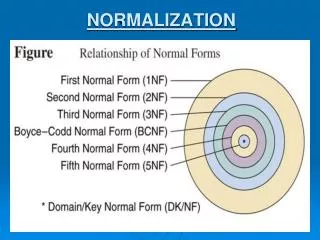
Fourth Normal Form • The redundancy that comes from MVD’s is not removable by putting the database schema in BCNF. • There is a stronger normal form, called 4NF, that (intuitively) treats MVD’s as FD’s when it comes to decomposition, but not when determining keys of the relation.
4NF Definition • A relation R is in 4NF if: whenever X ->->Y is a nontrivial MVD, then X is a superkey. • NontrivialMVD means that: • Y is not a subset of X, and • X and Y are not, together, all the attributes. • Note that the definition of “superkey” still depends on FD’s only.
Decomposition and 4NF • If X ->->Y is a 4NF violation for relation R, we can decompose R using the same technique as for BCNF. • XY is one of the decomposed relations. • All but Y – X is the other.
Example: 4NF Decomposition Drinkers(name, addr, phones, beersLiked) FD: name -> addr MVD’s: name ->-> phones name ->-> beersLiked • Key is {name, phones, beersLiked}. • All dependencies violate 4NF.
Example Continued • Decompose using name -> addr: • Drinkers1(name, addr) • In 4NF; only dependency is name -> addr. • Drinkers2(name, phones, beersLiked) • Not in 4NF. MVD’s name ->-> phones and name ->-> beersLiked apply. No FD’s, so all three attributes form the key.
Example: Decompose Drinkers2 • Either MVD name ->-> phones or name ->-> beersLiked tells us to decompose to: • Drinkers3(name, phones) • Drinkers4(name, beersLiked)
3NF, BCNF, 4NF 3NF BCNF 4NF