Mekong Basin Development Plan: Promoting Sustainable Growth and Regional Cooperation
The Mekong Basin Development Plan (BDP) aims to foster economic growth through a participatory approach that emphasizes investment and sustainable management of shared Mekong River resources, as outlined in the 1995 Agreement. Key strategies include balancing development opportunities with resource conservation, ensuring regional cooperation while addressing national interests, and enhancing public participation. The BDP involves comprehensive planning tools to identify joint projects, promote capacity building, and address trans-boundary impacts, ultimately contributing to sustainable basin-wide benefits.

Mekong Basin Development Plan: Promoting Sustainable Growth and Regional Cooperation
E N D
Presentation Transcript
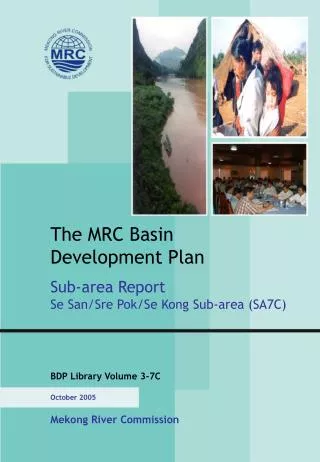
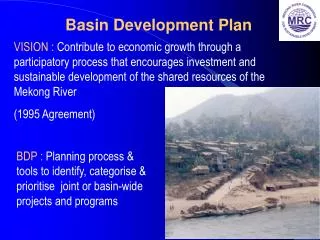
Basin Development Plan VISION : Contribute to economic growth through a participatory process that encourages investment and sustainable development of the shared resources of the Mekong River (1995 Agreement) BDP : Planning process & tools to identify, categorise & prioritise joint or basin-wide projects and programs
Basin Development Plan • Strategies : • Balancing development opportunities & resource conservation (social, economic, environmental) • Regional cooperation for basin-wide benefits – taking account of national interests and local issues • Integration of public participation • Capacity building by learning process
BDP APPROACH: COMPREHENSIVE, BASIN-WIDE & PARTICIPATORY BASIN DEVELOPMENT PLAN MRC Programmes WUP, EP, AI&F, Fish, Navigation, WRMP & Tourism TSD & HRD Regional Programmes Greater Mekong Sub-region, ASEAN-Mekong AEM-MITI National Programmes NMCs, Line Agencies, Universities, Research Inst, Bi-lateral, NGOs; Private Sector; Other Stakeholders.
BDP ORGANISATION MRC/JC NMCs Line Ministries, Local Authorities, others Secretariat BDP Sub- Committee NMC Secretariat Office of CEO Core Programmes Management Group Programme Coordination Group National BDP/Coordination Unit BDP Team Coordination Meeting Working Groups 1,2,3 etc. Sub-area working groups Ad hoc working Groups as needed
National Policies Regional common issues (irrigation, floods, fisheries, hydropower, navigation etc) Local (sub-area) requirements (mainly based on water balances) National Plans and Programmes NO Yes Yes Trans-boundary Factors Development/Management Scenarios Analysis of Trans-boundary Impacts Review Process Regional Strategies Projects and Programmes (with trans-boundary implications)
10 sub-areas 2 – 4 sub-areas in each country to reflect regional diversity - formulate regional strategies for water resources development, taking account of local issues Identify • main development needs and options • likely impacts of development • positive and negative • trans-boundary • social, economic and environmental
Sector Programmes Data on impacts and dependencies Data on water use Data on productive aspects of sectors - economic and social support for livelihoods Environment Programme Water Utilisation Programme Environmental impacts and interactions Water utilisation rules DSF Hydrological data and models Basin Development Plan Development and management strategies Project list Implementation of development and management