Download
1 / 8
80 likes | 208 Vues
Taoism teaches the acceptance of life as it is and encourages a philosophy of "wu-wei," or non-doing, allowing things to unfold naturally. Central to Taoism is the concept of yin and yang, representing complementary forces—light and dark, male and female, active and passive—that together create harmony. The Tao, meaning “The Way,” signifies a path influenced by both Buddhism and Confucianism. Key texts like the Tao Te Ching, attributed to Lao Tzu, encapsulate these beliefs, alongside the understanding of the five elements that shape natural processes.

E N D
The Philosophy • Humans should accept life as it is and not wish for life to be any other way • Wu-wei is a phrase that translates into “non-doing,” which means letting things come naturally • Yin and yang • Heaven, earth, and humanity all come from the yin and yang
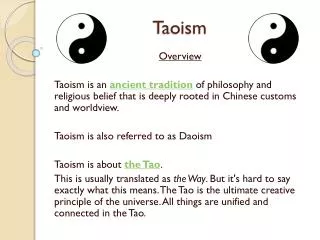
Yin and Yang • are complete opposites of each other but compliment each other • The white part of the symbol is male, heat, passive, day and heaven • The black part of the symbol is female, coolness, night, active, and earth • Black and white do not oppose each other, but they complete each other • Everything comes from the forces of yin and yang
The Religion • The symbol in the background is “Tao,” which means “The Way” • Taoism religion is blended with Buddhism and Confucianism • T’ai Chi is “Ultimate Cause,” which is the reason for everything in existence
Myths • The Jade Emperor -controlled the heavens • kuei -means ghosts -these ghost bring with them death
Tao-Te Ching • Written by a man named Lao –Tzu • It is a collection of all the beliefs of Taoism • These beliefs have been practiced since the b.c. era
The Five Elements • The five elements in Taoism are, from greatest to least important, water, fire, wood, metal, and earth • The elements are thought to produce all the seasons: wood/spring (wood gives birth to fire) fire/summer (fire gives birth to ash or earth. Earth then gives birth to metal) metal/autumn (metal gives birth to water) water/winter
Bibliography Occhiogrosso, Peter. The Joy of Sects. Doubleday: New York, 1994. 147-149. “Taoism” Wikipedia, the free encyclopedia. 4 Jan 2005. Wikipedia. 4Jan 2005. http://en.wikipedia.org/wiki/Taoist