The Catholic Counter-Reformation: Key Movements and Council of Trent Resolutions
This text examines the Counter-Reformation's key figures and events, focusing on Charles V's desire for a conciliar movement, which faced obstacles from Francis I of France. The Council of Trent (1545-1563), led by Paul III, rejected the notion of "faith alone," reaffirming the necessity of both faith and good works for salvation. Additionally, the Society of Jesus, founded by Ignatius Loyola, played a vital role in the Counter-Reformation through education and the suppression of heresy. This period significantly shaped Catholic doctrine and authority.

The Catholic Counter-Reformation: Key Movements and Council of Trent Resolutions
E N D
Presentation Transcript
Section 2.10 Catholicism Reformed and Reorganized
Catholic/Counter Reformation • Charles V wants a conciliar movement • Discouraged by Francis I • Fear of Hapsburg power (“Universal Monarchy”) • France • encourages Protestant princes • discourages Pope from negotiating with Protestants • Keeping Germany divided becomes characteristic of French foreign policy until 1870s
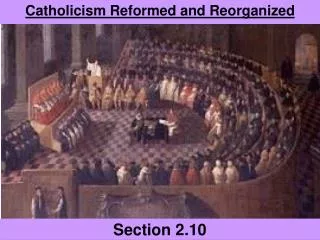
Council of Trent (1545-63) • Initiated by Paul III (1543-1549) • Not well attended • Main Resolutions • Rejected “faith alone” dogma • reaffirmed that both faith and good works are necessary for salvation • Bible (Vulgate), Church tradition & law all recognized sources of authority • Reaffirmed 7 sacraments, Latin, purgatory, cult of saints and Virgin, celibacy, monastic life
Council of Trent (1545-63) • Condemned abuses • Called for more educated clergy • Called for more religious art (Baroque developed) • Created Index of Prohibited Books • Erasmus, Galileo, Luther, Calvin • Reaffirmed absolute Papal authority (1870: Papal infallibility declared)
The Society of Jesus • Known as the Jesuits (1534) • The spiritual soldiers of Counter Reformation • Founded by Ignatius Loyola (1491-1556) • Military background • Absolute obedience to pope • Rigorous theological training • Politically influential • Founded universities and schools • Carried Catholic message abroad • Preserved Catholicism in Germany, Eastern Europe • Utilized Inquisition in Italy and Spain to suppress heresy
Spiritual Exercises by Ignatius Loyola • In what sense are these rules intended as a rebuttal of Protestant theology? Be specific. • What are the religious underpinnings of Rule 13? Be specific.