Divide and Conquer
This guide explores the Divide and Conquer paradigm, a fundamental technique in algorithm design. We break down the process into three key steps: dividing the problem into subproblems, recursively solving those subproblems, and combining their solutions to solve the original problem. The text presents the recurrence relations that help analyze the running time of algorithms like Mergesort and quicksort, along with the Master theorem for solving recurrences. Additional applications and examples illustrate the versatility of the Divide and Conquer strategy across various computational problems.

Divide and Conquer
E N D
Presentation Transcript
Divide and Conquer Andreas Klappenecker [based on slides by Prof. Welch]
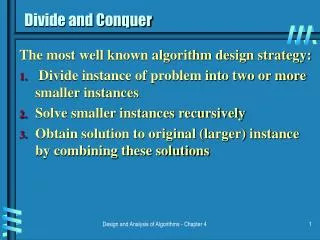
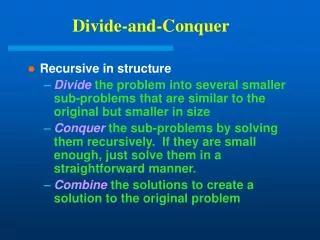
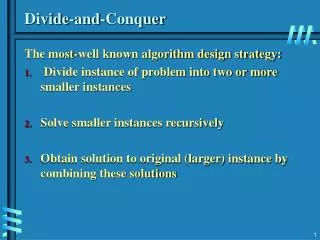
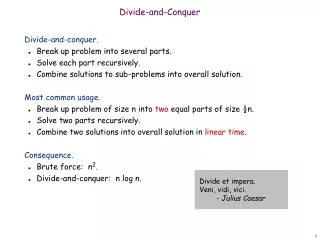
Divide and Conquer Paradigm • An important general technique for designing algorithms: • divide problem into subproblems • recursively solve subproblems • combine solutions to subproblems to get solution to original problem • Use recurrences to analyze the running time of such algorithms
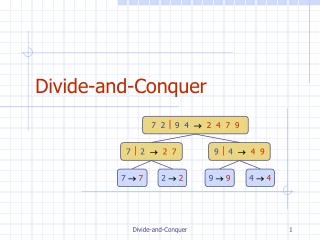
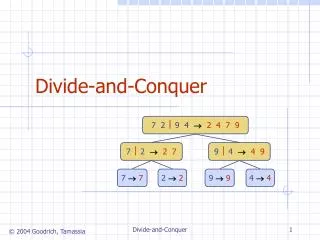
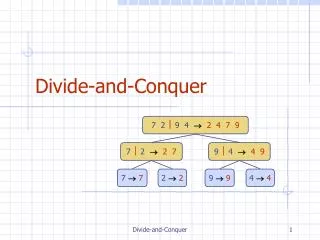
Example: Mergesort • DIVIDE the input sequence in half • RECURSIVELY sort the two halves • basis of the recursion is sequence with 1 key • COMBINE the two sorted subsequences by merging them
1 5 2 2 4 2 3 6 4 1 5 3 6 2 6 6 2 5 2 4 4 5 6 6 1 1 2 3 3 2 6 6 5 2 5 2 5 2 4 4 6 6 1 1 3 3 2 2 6 6 4 6 2 6 1 3 Mergesort Example
Mergesort Animation • http://ccl.northwestern.edu/netlogo/models/run.cgi?MergeSort.862.378
Recurrence Relation for Mergesort • Let T(n) be worst case time on a sequence of n keys • If n = 1, then T(n) = (1) (constant) • If n > 1, then T(n) = 2 T(n/2) + (n) • two subproblems of size n/2 each that are solved recursively • (n) time to do the merge
How To Solve Recurrences • Ad hoc method: • expand several times • guess the pattern • can verify with proof by induction • Master theorem • general formula that works if recurrence has the form T(n) = aT(n/b) + f(n) • a is number of subproblems • n/b is size of each subproblem • f(n) is cost of non-recursive part
Master Theorem Consider a recurrence of the form T(n) = a T(n/b) + f(n) with a>=1, b>1, and f(n) eventually positive. • If f(n) = O(nlogb(a)-), then T(n)=(nlogb(a)). • If f(n) = (nlogb(a) ), then T(n)=(nlogb(a) log(n)). • If f(n) = (nlogb(a)+) and f(n) is regular, then T(n)=(f(n)) [f(n) regular iff eventually af(n/b)<= cf(n) for some constant c<1]
Excuse me, what did it say??? Essentially, the Master theorem compares the function f(n) with the function g(n)=nlogb(a). Roughly, the theorem says: • If f(n) << g(n) then T(n)=(g(n)). • If f(n) g(n) then T(n)=(g(n)log(n)). • If f(n) >> g(n) then T(n)=(f(n)). Now go back and memorize the theorem!
Déjà vu: Master Theorem Consider a recurrence of the form T(n) = a T(n/b) + f(n) with a>=1, b>1, and f(n) eventually positive. • If f(n) = O(nlogb(a)-), then T(n)=(nlogb(a)). • If f(n) = (nlogb(a) ), then T(n)=(nlogb(a) log(n)). • If f(n) = (nlogb(a)+) and f(n) is regular, then T(n)=(f(n)) [f(n) regular iff eventually af(n/b)<= cf(n) for some constant c<1]
Nothing is perfect… The Master theorem does not cover all possible cases. For example, if f(n) = (nlogb(a) log n), then we lie between cases 2) and 3), but the theorem does not apply. There exist better versions of the Master theorem that cover more cases, but these are even harder to memorize.
Idea of the Proof Let us iteratively substitute the recurrence:
Idea of the Proof Thus, we obtained T(n) = nlogb(a) T(1) + ai f(n/bi) The proof proceeds by distinguishing three cases: • The first term in dominant: f(n) = O(nlogb(a)-) • Each part of the summation is equally dominant: f(n) = (nlogb(a) ) • The summation can be bounded by a geometric series: f(n) = (nlogb(a)+) and the regularity of f is key to make the argument work.
Additional D&C Algorithms • binary search • divide sequence into two halves by comparing search key to midpoint • recursively search in one of the two halves • combine step is empty • quicksort • divide sequence into two parts by comparing pivot to each key • recursively sort the two parts • combine step is empty
Additional D&C applications • computational geometry • finding closest pair of points • finding convex hull • mathematical calculations • converting binary to decimal • integer multiplication • matrix multiplication • matrix inversion • Fast Fourier Transform
Matrix Multiplication • Consider two n by n matrices A and B • Definition of AxB is n by n matrix C whose (i,j)-th entry is computed like this: • consider row i of A and column j of B • multiply together the first entries of the rown and column, the second entries, etc. • then add up all the products • Number of scalar operations (multiplies and adds) in straightforward algorithm is O(n3). • Can we do it faster?
Divide-and-Conquer • Divide matrices A and B into four submatrices each • We have 8 smaller matrix multiplications and 4 additions. Is it faster? A B= C =
Divide-and-Conquer Let us investigate this recursive version of the matrix multiplication. Since we divide A, B and C into 4 submatrices each, we can compute the resulting matrix C by • 8 matrix multiplications on the submatrices of A and B, • plus (n2) scalar operations
Divide-and-Conquer • Running time of recursive version of straightfoward algorithm is • T(n) = 8T(n/2) + (n2) • T(2) = (1) where T(n) is running time on an n x n matrix • Master theorem gives us: T(n) = (n3) • Can we do fewer recursive calls (fewer multiplications of the n/2 x n/2 submatrices)?
Strassen’s Matrix Multiplication A B= C = P1 = (A11+ A22)(B11+B22) P2 = (A21 + A22) * B11P3 = A11 * (B12 - B22) P4 = A22 * (B21 - B11) P5 = (A11 + A12) * B22P6 = (A21 - A11) * (B11 + B12) P7 = (A12 - A22) * (B21 + B22) C11 = P1 + P4 - P5 + P7C12 = P3 + P5C21 = P2 + P4C22 = P1 + P3 - P2 + P6
Strassen's Matrix Multiplication • Strassen found a way to get all the required information with only 7 matrix multiplications, instead of 8. • Recurrence for new algorithm is • T(n) = 7T(n/2) + (n2)
Solving the Recurrence Relation Applying the Master Theorem to T(n) = a T(n/b) + f(n) with a=7, b=2, and f(n)=(n2). Since f(n) = O(nlogb(a)-) = O(nlog2(7)-), case a) applies and we get T(n)= (nlogb(a)) = (nlog2(7)) = O(n2.81).
Discussion of Strassen's Algorithm • Not always practical • constant factor is larger than for naïve method • specially designed methods are better on sparse matrices • issues of numerical (in)stability • recursion uses lots of space • Not the fastest known method • Fastest known is O(n2.376) • Best known lower bound is (n2)