Amphibians
Amphibians, derived from the Greek for "both" and "life," are a unique class of animals that emerged during the Devonian period. They possess adaptations such as four limbs, lungs for breathing, and a three-chambered heart that enables them to thrive both in water and on land. Common types include frogs, toads, newts, and salamanders, with diverse reproductive strategies like external fertilization. These ectothermic creatures exhibit dormancy and play vital roles in their ecosystems, demonstrating fascinating life stages from tadpoles to adults.

Amphibians
E N D
Presentation Transcript
Amphibia • Comes from the Greek amphi “both” and bios “life” • Appeared during the Devonian period
Adaptations • Four limbs • Lungs instead of gills • Both internal & external nares (nostrils) • Three chambered heart (two atria & one ventricle)
Skin with keratin (protein) to prevent water loss • Most with smooth, moist skin to take in dissolved oxygen • Some with oral glands to moisten food they eat
Ectothermic - body temperature changes with environment • Show dormancy or torpor (state of inactivity during unfavorable environmental conditions) • Hibernate in winter and aestivate in summer • Males with vocal sacs to croak • Digested system adapted to swallow prey whole • Well developed muscular system
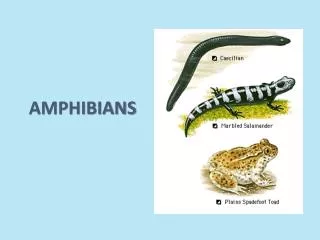
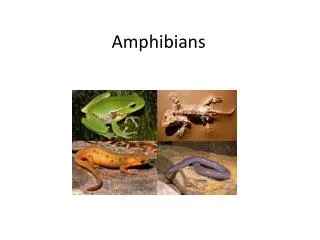
Anura • Frogs • Toads
Characteristics • Both terrestrial & freshwater species • Tadpole with tail, gills, & two-chambered heart • Adults without a tail, four limbs, & lungs • Frog skin smooth & moist for cutaneous respiration, while toads is rough & warty (poison glands)
Aquatic larva called tadpole goes through metamorphosis to adult • Metamorphosis controlled by hormone called thyroxine
Reproduction • External fertilization with amplexus (male clasps back of female as sperm & eggs deposited into water)
Eggs coated with sticky, jelly like material so they attach to objects in water & do not float away • Eggs hatch into tadpoles in about 12 days
Caudata • Newts and Salamanders
Characteristics • Have elongated bodies with a tail & four limbs • Smooth, moist skin for cutaneous respiration • Size from a few centimeters long to 1.5 meters • Nocturnal when live in drier areas • Newts are aquatic species
Lay eggs in water or damp soil • Some bear live young • May or may not go through tadpole stage (some hatch & look like small adult) • All newts are salamanders but not all salamanders are newts
Apoda • caecilians
Tropical, burrowing, worm like amphibians • Legless • Small eyes & often blind • Eat worms & other invertebrates • Average length 30 centimeters, but can grow up to 1.3 meters • internal fertilization • Female bear live young