Observations of Coronal Cavities and Prominences by Hinode
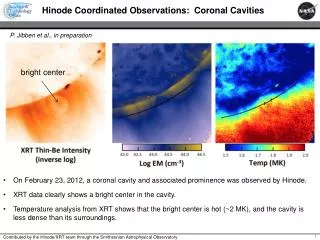
On February 23, 2012, the Hinode satellite observed a coronal cavity and an associated prominence, revealing significant features through its instruments. X-ray Telescope (XRT) data indicated a bright center within the cavity with a temperature of approximately 2 MK, suggesting a higher thermal state compared to its surroundings. Additionally, an Extreme Ultraviolet Imaging Spectrometer (EIS) survey showed a partial ring of red-shifted emission surrounding the bright core. These coordinated observations aim to enhance our understanding of flux rope structures and their thermodynamic properties.

Observations of Coronal Cavities and Prominences by Hinode
E N D
Presentation Transcript
Hinode Coordinated Observations: Coronal Cavities P. Jibben et al., in preparation bright center • On February 23, 2012, a coronal cavity and associated prominence was observed by Hinode. • XRT data clearly shows a bright center in the cavity. • Temperature analysis from XRT shows that the bright center is hot (~2 MK), and the cavity is less dense than its surroundings. Contributed by the Hinode/XRT team through the Smithsonian Astrophysical Observatory
Hinode Coordinated Observations: Coronal Cavities P. Jibben et al., in preparation • EIS scanned the region of the cavity, showing a partial ring of red-shifted emission. • The contours of the red-shifted emission are shown on an EIS raster and an XRT image – the red-shifted plasma surrounds the bright core viewed by XRT. Contributed by the Hinode/XRT team through the Smithsonian Astrophysical Observatory
Hinode Coordinated Observations: Coronal Cavities • SOT images of the associated prominence in Hα red wing and blue wing give information about the prominence motion • Data from the three Hinode instruments are complementary, and explore the structure’s dynamics, morphology and thermodynamics. • Goal is to understand the structure of the flux rope which is the source of the hot center cavity P. Jibben et al., in preparation Contributed by the Hinode/XRT team through the Smithsonian Astrophysical Observatory