Enhancing STI Management in Conflict Settings: Lessons from Rwandan Camps and Sierra Leone
This report examines strategies for addressing sexually transmitted infections (STIs) in conflict zones, particularly focusing on Rwandan refugee camps in Tanzania (1994-96) and Sierra Leone (2001-2003). Key approaches included raising community awareness and improving syndromic case management in Rwanda, leading to a significant increase in reported STIs from 20 to 250 per week. In Sierra Leone, behavior change communication (BCC), condom distribution, and targeted STI treatment for youth, commercial sex workers, and military personnel resulted in improved knowledge of STI signs and care-seeking behaviors.

Enhancing STI Management in Conflict Settings: Lessons from Rwandan Camps and Sierra Leone
E N D
Presentation Transcript
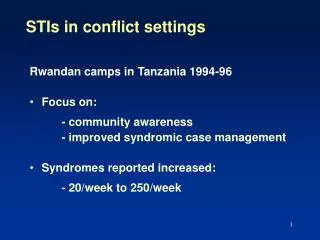
STIs in conflict settings Rwandan camps in Tanzania 1994-96 • Focus on: - community awareness - improved syndromic case management • Syndromes reported increased: - 20/week to 250/week
STIs in conflict settings Sierra Leone 2001-2003 • Focus on: - BCC - Condom distribution - STI treatment • Target groups: youth, CSWs, military • Improvements in all groups on: - Knowledge of STI signs - Sources of STI care - Need to seek care quickly