Understanding Human Genetics: Chromosomes, Disorders, and Inheritance Patterns
200 likes | 307 Vues
This chapter covers key concepts of human heredity, including autosomes and sex chromosomes, karyotypes, and the impact of nondisjunction on genetic disorders such as Down syndrome and Turner syndrome. It discusses genetic traits and disorders, including recessive traits and common blood groups, emphasizing the implications of sex-linked traits like color blindness and hemophilia. Through pedigrees, we explore family histories and inheritance patterns, demonstrating how genes influence traits and health across generations.


Understanding Human Genetics: Chromosomes, Disorders, and Inheritance Patterns
E N D
Presentation Transcript
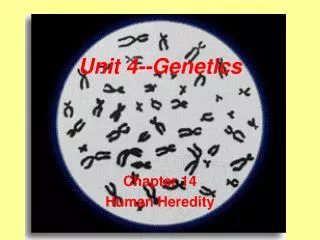
Unit 4--Genetics Chapter 14 Human Heredity
1) Autosomes all the chromosomes except the sex chromosomes (in humans, there are 22 pair) 2) Sex chromosomes The sex-determining chromosomes, the X & Y
3) Karyotype Pictures of paired human chromosomes arranged by size, used to identify abnormalities in fetuses Cells from an amniotic fluid sample are cultured, stained & photographed
4) Nondisjunction Failure of chromosomes to separate May cause a variety of birth defects, including trisomy 21 or Down syndrome
Turner’s syndrome Only 1 sex chromosome is present. Turner syndrome is associated with underdeveloped ovaries, short stature, webbed neck, and broad chest. Individuals are sterile, and lack expected secondary sexual characteristics. Mental retardation typically not evident . XX XX O
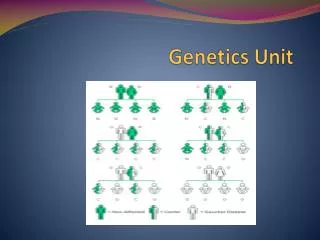
5) Pedigree • Chart showing family history of a trait • Solid light = homozygous dominant, solid dark = homozygous recessive, half-circle = heterozygous
6) Blood groups % of U.S. population
Serum Universal recipient Universal donor
7) Genetic disorders Harmful effects produced by mutated genes, most are recessive and few are lethal Example: sickle cell anemia
Normal, with malarial resistance Same as parents ; normal, no resistance; sickle-cell anemia
8) Sex-linked traits A recessive gene on the X chromosome Examples: color-blindness & hemophilia Genotypes: Phenotypes: XNY normal male XnY colorblind XNXN normal female XNXn carrier female XnXn colorblind
normal vision “weak red” “weak green”
Cross of carrier female & normal male Xn XN XN XNXN XNXn Y XNY XnY Phenotypes???
Carrier Mom XHXh XHXH XHXh XHY XhY