Understanding the Hopes and Aims of the Big Three Leaders in 1945
This activity focuses on the hopes and aims of the Big Three leaders—Roosevelt, Churchill, and Stalin—during the post-World War II period in 1945. Students will explore the perspectives of the Grand Alliance members and how they influenced their countries' stances towards Europe’s future. Through collaborative research, group presentations, and a Venn diagram exercise, students will discover similarities and differences in national objectives. They will also learn effective presentation techniques to enhance their communication skills.

Understanding the Hopes and Aims of the Big Three Leaders in 1945
E N D
Presentation Transcript
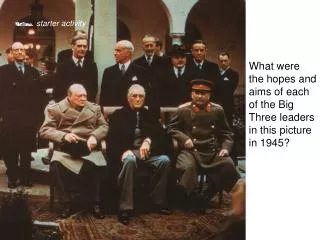
What were the hopes and aims of each of the Big Three leaders in this picture in 1945? starter activity
What were the attitudes of the main powers to the situation in Europe in 1945? Aims Identify the hopes and aims of members of the Grand Alliance?
George Kennan (1904-2005) How influential was this senior US diplomat on US foreign policy during the Cold War?
Your task • Divide into 3 groups. Each group is going to take responsibility for explaining the hopes and aims of their government for Europe in 1945. Use Phillips, p.19-22 as a starting point, but also conduct your own research using Studyhistory weblinks and resources in the classroom. • Produce an A4 handout to give to members of your class.
What makes an effective presentation? Give me 5 do NOTs and 5 DOs for success.
Your task • Create a 3 ring Venn diagram. Record the aims and hopes of each member of the Grand Alliance in the main area of the circle and where they are shared with other nations record these in the overlaps.
Plenary • What similarities are there between the hopes and aims of these countries?