Understanding Knowledge: Definitions, Truth Theories, and the Gettier Problem
This text explores the definition of knowledge, emphasizing the necessary conditions for claiming to know something: that one believes it to be true, has justification for this belief, and that it is, in fact, true. It discusses the Gettier problem, demonstrating that one can have a justified true belief and still lack knowledge. Additionally, it examines various theories of truth, including correspondence, coherence, and pragmatic theories, along with their objections, highlighting the nuances and complexities in understanding truth and knowledge.

Understanding Knowledge: Definitions, Truth Theories, and the Gettier Problem
E N D
Presentation Transcript
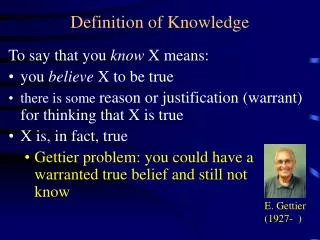
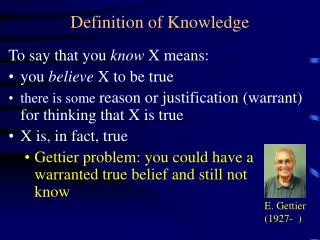
Definition of Knowledge To say that you know X means: • you believe X to be true • there is some reason or justification (warrant) for thinking that X is true • X is, in fact, true • Gettier problem: you could have a warranted true belief and still not know E. Gettier (1927- )
Theories of Truth • Correspondence: truth is an objective relation between beliefs and extramental reality (i.e., facts) • Objection: we cannot access extramental reality • Coherence: a proposition or belief is true if it is coherent with other accepted beliefs • Objection: coherent systems of intersubjectively accepted beliefs could still be false • Pragmatic: if acting on a belief satisfies our expectations—that is, if it works—it is true • Objections: (a) justified beliefs are not necessarily true; (b) this make all truths relative; (c) beliefs are not true because they “work”; they work because they are true