
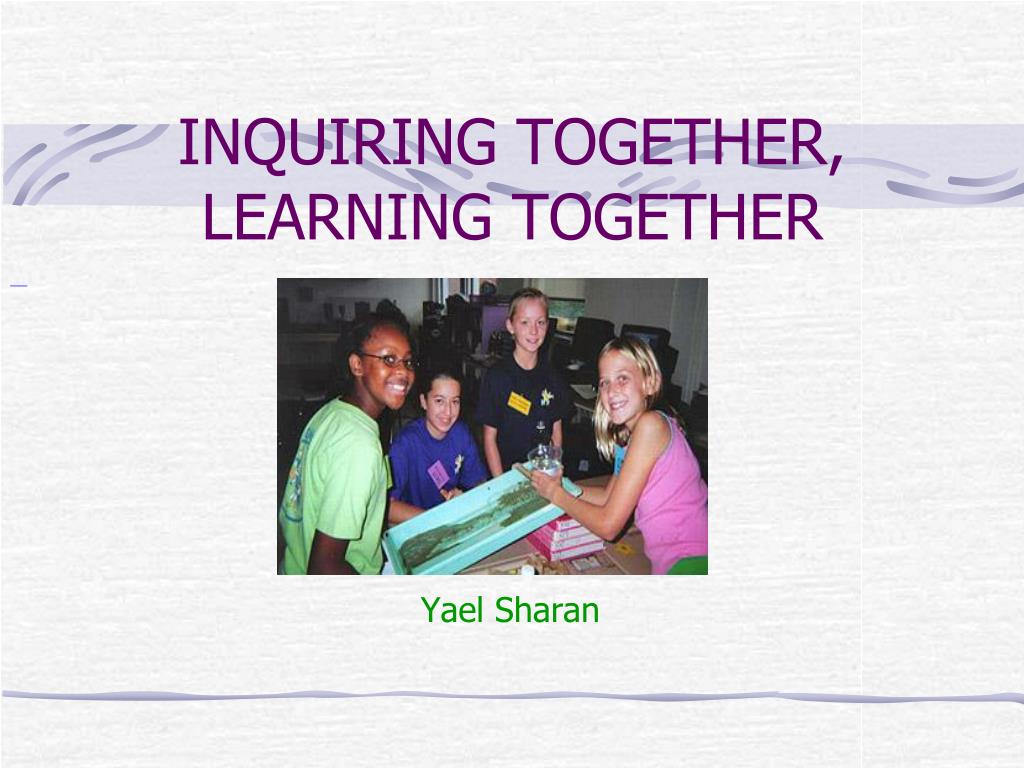
INQUIRING TOGETHER, LEARNING TOGETHER

This comprehensive overview of cooperative learning emphasizes the importance of diverse methods and models that enable groups to work towards common goals while fostering interdependence. It highlights the positive effects of collaborative environments on students' social skills, self-esteem, and higher-order thinking. Key elements such as investigation, interaction, interpretation, and intrinsic motivation are explored, showcasing how inquiry-based learning cultivates a vibrant community of learners. Discover how effective group work can create an engaging atmosphere for knowledge construction.
Télécharger la présentation 
Politique de téléchargement : le contenu du site vous est fourni TEL QUEL pour votre information et votre usage personnel ; il ne peut être vendu, concédé sous licence ni partagé sur d’autres sites sans l’accord de son auteur.Le contenu vous est fourni TEL QUEL, pour votre information et votre usage personnel uniquement. Téléchargez la présentation en cliquant sur ce lien. Lors du téléchargement, si vous ne parvenez pas à télécharger une présentation, l’éditeur a peut-être supprimé le fichier de son serveur.Pendant le téléchargement, si vous ne parvenez pas à obtenir une présentation, le fichier a peut-être été supprimé par l’éditeur.
F I N