Mastering Active Listening: Skills, Practices, and Engaging Activities
This guide focuses on developing active listening skills through engaging partner activities and reflective questions. Participants will share their favorite Disney characters and dream houses, enhancing their ability to listen with understanding and empathy. The activity encourages assessing interaction through eye contact, interruptions, and engagement. Key learning targets include defining active listening, recognizing its significance, and practicing attentive behaviors such as nodding and summarizing responses. The day concludes with creative sharing about personal dreams and aspirations, reinforcing the importance of listening in communication.

Mastering Active Listening: Skills, Practices, and Engaging Activities
E N D
Presentation Transcript
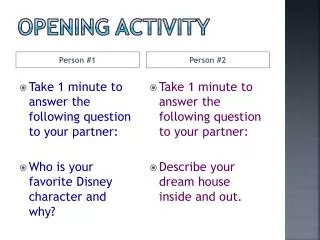
Opening Activity • Take 1 minute to answer the following question to your partner: • Who is your favorite Disney character and why? • Take 1 minute to answer the following question to your partner: • Describe your dream house inside and out. Person #1 Person #2
Thumbs up or Thumbs down • Did your partner make eye contact with you while you were talking? • Did your partner interrupt you at any point? • Did your partner ask you any questions about your answer? • Did your partner seem interested in your answer? • Why or why not?
Learning Targets and Essential Question • I can actively listen when a person speaks. • I can define active listening. • What does it look and sound like to actively listen? Learning Targets Essential Question
Quote of The Day • How can listening more than talking help make a person successful? • How do you show you are listening when a teacher is talking? • How about when a friend is talking?
Definitions • Listening with understanding and empathy. • Physically showing you are listening. • Seek to understand others. • Be able to put yourself in their shoes. Active Listening Empathy
The three Ways To Actively Listen • Pay attention • Show that you are listening • Provide feedback
Pay Attention • Don't mentally prepare a rebuttal • Avoid being distracted by environmental factors. For example, side conversations. • "Listen" to the speaker's body language.
Pay Attention • Give the speaker your undivided attention. • Look at the speaker directly. • Put aside distracting thoughts.
Show You are Listening • Use your own body language and gestures to Show your attention. • Nod occasionally. • Smile and use other facial expressions.
Show You are Listening • Note your posture and make sure it is open and inviting. • Encourage the speaker to continue with small verbal comments like yes, and uh huh.
Provide Feedback • Use phrases like “What I hear you saying is…” • Summarize what the person is saying. • Avoid responding with a sentence that starts with “I”.
Provide Feedback • Do not interrupt let the speaker finish. • Defer judgment- Don’t argue • Respond appropriately-Be Respectful • Empathize with the speaker-put yourself in their shoes.
Movie Clip Questions • Did Erin Actively listen? • What mistakes did Erin make? • What are some consequences that could have happened due to Erin’s poor Listening? • Empathize with Erin’s boss, how might he feel after this conversation
Today’s Assignment • Think about all the ways we learned to actively listen today. • Fill out TWO of the empty circles with words you might SAY to show you are actively listening. • Fill out TWO of the empty squares with things you might DOto show you are actively listening.
Closing Activity • Take 1 minute to answer the following question to your partner: • If you won the lottery, what would you do? • Take 1 minute to answer the following question to your partner: • What is your full name and how was it decided on? Person #1 Person #2