Understanding Speed, Velocity, and Acceleration in Motion
This activity explores the essential concepts of speed, velocity, acceleration, distance, and displacement. Students will compare and contrast these fundamental terms and solve practical problems involving a cyclist traveling 800 km at an average speed. They will learn how to calculate average acceleration using real-life examples, like a jet airliner and a skateboarder. Through engaging activities, students will understand the relationships between time, velocity, and acceleration, and differentiate between positive and negative acceleration.

Understanding Speed, Velocity, and Acceleration in Motion
E N D
Presentation Transcript
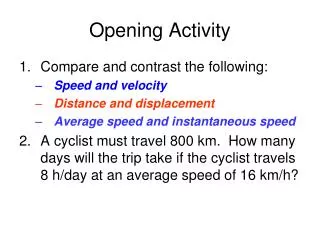
Opening Activity • Compare and contrast the following: • Speed and velocity • Distance and displacement • Average speed and instantaneous speed • A cyclist must travel 800 km. How many days will the trip take if the cyclist travels 8 h/day at an average speed of 16 km/h?
3.2 Acceleration pp 76-80Essential Questions • How are time, velocity, and acceleration related? • How do I calculate the average acceleration of an object? • What is positive and negative acceleration and how are they different?
Acceleration, Speed, and Velocity p 76 • When a car takes from a stop, the car’s velocity increases. It also accelerates. • Acceleration is the change in velocity divided by the time for the change to occur
Acceleration, Speed, and Velocity p 76 • When a car slows down and stops, the car’s velocity decreases. It also accelerates (deceleration).
Changing Direction p 77 • Acceleration occurs when an object changes its speed, its direction, or both. • We now have three terms that have magnitude (size) and direction; these are vectors. Name the other two vectors we have covered
Changing Direction p 77 • Any time a moving object changes direction, its velocity changes and it is accelerating.
Calculating Acceleration • = • Standard units = m/s2 • If a = 1 m/s2, it means that its velocity (speed) is increasing 1 m/s every second.
Suppose a jet airliner starts at rest at the end of a runway and reaches a speed of 80 m/s in 20 s.What is the plane’s average acceleration?
Suppose a jet airliner starts at rest at the end of a runway and reaches a speed of 80 m/s in 20 s.What is the plane’s average acceleration? • vi = _____ vf = ______ Δt = _____
Suppose a jet airliner starts at rest at the end of a runway and reaches a speed of 80 m/s in 20 s.What is the plane’s average acceleration? • vi = 0 m/s vf = ______ Δt = _____
Suppose a jet airliner starts at rest at the end of a runway and reaches a speed of 80 m/s in 20 s.What is the plane’s average acceleration? • vi = 0 m/s vf = 80 m/s Δt = _____
Suppose a jet airliner starts at rest at the end of a runway and reaches a speed of 80 m/s in 20 s.What is the plane’s average acceleration? • vi = 0 m/s vf = 80 m/s Δt = 20 s
Suppose a jet airliner starts at rest at the end of a runway and reaches a speed of 80 m/s in 20 s.What is the plane’s average acceleration? • vi = 0 m/s vf = 80 m/s Δt = 20 s
Suppose a jet airliner starts at rest at the end of a runway and reaches a speed of 80 m/s in 20 s.What is the plane’s average acceleration? • vi = 0 m/s vf = 80 m/s Δt = 20 s • =
Suppose a jet airliner starts at rest at the end of a runway and reaches a speed of 80 m/s in 20 s.What is the plane’s average acceleration? • vi = 0 m/s vf = 80 m/s Δt = 20 s • = =
Suppose a jet airliner starts at rest at the end of a runway and reaches a speed of 80 m/s in 20 s.What is the plane’s average acceleration? • vi = 0 m/s vf = 80 m/s Δt = 20 s • = = =
Suppose a jet airliner starts at rest at the end of a runway and reaches a speed of 80 m/s in 20 s.What is the plane’s average acceleration? • vi = 0 m/s vf = 80 m/s Δt = 20 s • = = = = 2.0 m/s2
Now imagine that a skateboarder is moving in a straight line at a constant speed of 3 m/s and comes to a stop in 2 seconds. What is the skateboard’s average acceleration?
Now imagine that a skateboarder is moving in a straight line at a constant speed of 3 m/s and comes to a stop in 2 seconds. What is the skateboard’s average acceleration? • vi = _____ vf = _____ Δt = _____
Now imagine that a skateboarder is moving in a straight line at a constant speed of 3 m/s and comes to a stop in 2 seconds. What is the skateboard’s average acceleration? • vi = 3 m/s vf = 0 m/s Δt = 2 s
Now imagine that a skateboarder is moving in a straight line at a constant speed of 3 m/s and comes to a stop in 2 seconds. What is the skateboard’s average acceleration? • vi = 3 m/s vf = 0 m/s Δt = 2 s • =
Now imagine that a skateboarder is moving in a straight line at a constant speed of 3 m/s and comes to a stop in 2 seconds. What is the skateboard’s average acceleration? • vi = 3 m/s vf = 0 m/s Δt = 2 s • = =
Now imagine that a skateboarder is moving in a straight line at a constant speed of 3 m/s and comes to a stop in 2 seconds. What is the skateboard’s average acceleration? • vi = 3 m/s vf = 0 m/s Δt = 2 s • = = = = -1.5 m/s2
Opening Activity • It takes a car one minute (60 seconds) to go from a dead stop to a speed of 40 m/s. What is the average acceleration of the car? • A truck cruising at 50 m/s slams on its brakes to avoid a collision, stopping in 3.5 s. What is the acceleration of the truck
Opening Activity • It takes a car one minute (60 seconds) to go from a dead stop to a speed of 40 m/s. What is the average acceleration of the car?
Opening Activity • It takes a car one minute (60 seconds) to go from a dead stop to a speed of 40 m/s. What is the average acceleration of the car?t = 60svi = 0 m/svf = 40 m/sa = ???
Opening Activity • It takes a car one minute (60 seconds) to go from a dead stop to a speed of 40 m/s. What is the average acceleration of the car?t = 60svi = 0 m/svf = 40 m/sa = ??? = (vf – vi)/(tf – ti)=(40-0)/60 = 0.67 m/s2
Opening Activity • A truck cruising at 50 m/s slams on its brakes to avoid a collision, stopping in 3.5 s. What is the acceleration of the truck?
Opening Activity • A truck cruising at 50 m/s slams on its brakes to avoid a collision, stopping in 3.5 s. What is the acceleration of the truck?t = 3.5svi = 50 m/svf = 0 m/sa = ???
Opening Activity • A truck cruising at 50 m/s slams on its brakes to avoid a collision, stopping in 3.5 s. What is the acceleration of the truck?t = 3.5svi = 50 m/svf = 0 m/sa = ??? = (vf – vi)/(tf – ti)=(0-50)/3.5 = -14.29 m/s2
Speed-Time Graphs – Calculating Positive Acceleration • = = = = 2.0 m/s2
Speed-Time Graphs – Calculating Negative Acceleration • = = = = -1.5 m/s2
3.2 Homework • p 80 1-7 (All classes) • p 880 26-28, 30-32 (Honors)