Download
1 / 7
70 likes | 205 Vues
This unit explores Newton's First Law of Motion, emphasizing inertia—the tendency of objects to remain at rest or in motion until acted upon by a force. We define a force as a push, pull, or twist that can cause an object to accelerate, decelerate, change direction, or alter its shape. The unit categorizes forces into contact (like friction and lift) and non-contact (such as weight and electrostatic force). Discussions include sensations experienced on roller coasters and the importance of seatbelts, demonstrating the practical application of these concepts.

E N D
Unit 6.3 physics Newtons 1st law
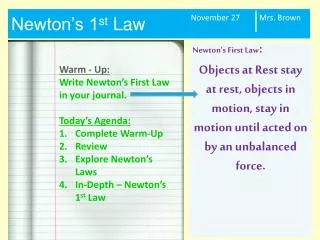
Inertia • An object at rest will stay that way unless a force acts on it • An object in motion will continue to move in the same direction and speed until a force acts on it.
What is a force? A force is a push, pull or twist that can cause an object to • Accelerate (increase its speed) • Decelerate (decrease its speed) • Change its direction • Change its shape
Types of forces [contact] • Friction • Air resistance or drag • Buoyancy • Surface tension • Lift • Thrust
Types of forces [non contact] • Weight • Electrostatic • Magnet
Discussion • Explain why you feel heavier than normal at the bottom of a roller coaster and lighter at the top? • Outline what is the purpose of headrest in a car. • Explain why you should wear seatbelts in a car.
Place the following words in a sentence • Force • Contact • Inertia • Buoyancy • Surface Tension • Lift • Thrust • Weight