Understanding Convective Storm Types: Archetypes and Numerical Model Comparisons
670 likes | 807 Vues
This presentation explores the archetypes of convective storms, including Ordinary Cells, Multicells, and Supercells. Each type is characterized by unique lifecycle dynamics, such as propagation patterns and interaction with wind shear. The talk will discuss the physical processes that govern these storm categories, including buoyancy, gust front triggering, and dynamic pressure effects. Additionally, it will compare numerical models' effectiveness in reproducing the observed spectrum of these storm types, contributing to a better understanding of convective storm behavior.


Understanding Convective Storm Types: Archetypes and Numerical Model Comparisons
E N D
Presentation Transcript
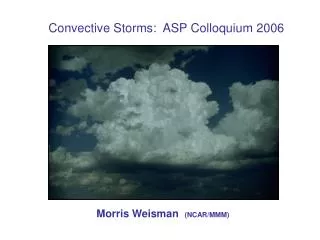
Convective Storms: ASP Colloquium 2006 Morris Weisman (NCAR/MMM)
Archetypes: Building blocks of the observed spectrum Ordinary Cells:short lived (30-60 min), propagate with the mean wind Multicells:long-lived group of ordinary cells Supercells:quasi-steady, rotating, propagate right or left of the vertical wind shear vector
Supercells propagate to right and/or left of the mean vertical wind shear vector
So, how well do numerical models reproduce this observed spectrum?? Comet Web Modules: htpp://meted.ucar.edu/topics_convective.php • Convective Storm Matrix • MCS Matrix
Physical processes controlling cell types: • Buoyancy processes: basic updraft/downdraft, (ordinary cells) • Gust front processes: triggering of new cells, upscale growth, (multicells) • Dynamic processes: rotating updraft, dynamic vertical pressure gradient forcing, (supercells)
1/2 Wmax = (2 CAPE)
Physical processes controlling cell types: • Buoyancy processes: basic updraft/downdraft, (ordinary cells) • Gust front processes: triggering of new cells, upscale growth, (multicells) • Dynamic processes: rotating updraft, dynamic vertical pressure gradient forcing, (supercells)
Density Current: Theoretical speed of propagation:
RKW Theory Rotunno et al. (JAS, 1988) C/∆u > 1 “Optimal”condition for cold pool lifting C/∆u = 1 C/∆u < 1
Physical processes controlling cell types: • Buoyancy processes: basic updraft/downdraft, (ordinary cells) • Gust front processes: triggering of new cells, upscale growth, (multicells) • Dynamic processes: rotating updraft, dynamic vertical pressure gradient forcing, (supercells)
Dynamic Pressure Effects: (take divergence) diagnostic pressure eq. Dynamic pressure Buoyancy pressure Vertical momentum:
~ Updraft growing in sheared environment: