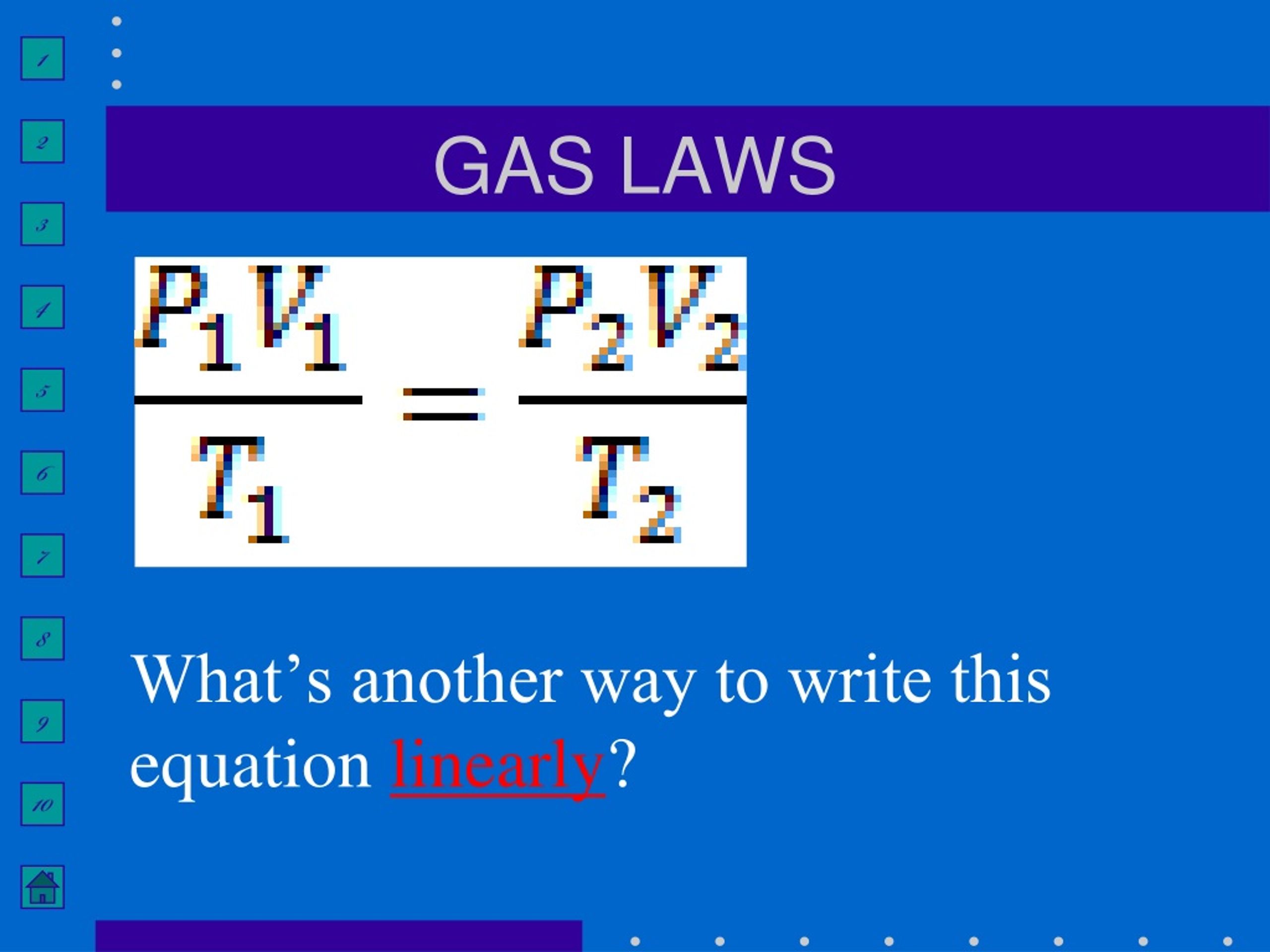
GAS LAWS • What’s another way to write this equation linearly?
Combined Gas Law • P1V1T2 = P2V2T1
Boyle’s Law (constant T) • P1V1T2 = P2V2T1 • ?
Boyle’s Law • P1V1T2 = P2V2T1 • P1V1T2 = P2V2T1 P1V1= P2V2
Charles’ Law (constant P) • P1V1T2 = P2V2T1 • ?
Charles’ Law • P1V1T2 = P2V2T1 • P1V1T2 = P2V2T1 V1T2 = V2T1
Gay-Lussac’s Law (constant V) • P1V1T2 = P2V2T1 • ?
Gay-Lussac’s Law • P1V1T2 = P2V2T1 • P1V1T2 = P2V2T1 P1T2 = P2T1
Gas Law Problems • P1 = • V1 = • T1 = • P2 = • V2 = • T2 = *Remember Temp has to be in Kelvin's, so: K = oC + 273 **Get your CALCULATORS READY!
P1V1T2 = P2V2T1 Gas Laws Practice Problems 1) Write your answer and state which gas law is being used to solve each. CLICK TO START
QUESTION #1 • Helium occupies 3.8 L at -45°C. What volume will it occupy at 45°C? ANSWER
ANSWER #1 CHARLES’ LAW P1V1T2 = P2V2T1 V2 = 5.3 L • V1 = 3.8 L • T1 = -45°C = 228 K • V2 = ? • T2 = 45°C = 318 K BACK TO PROBLEM NEXT
QUESTION #2 • Ammonia gas occupies a volume of 450. mL at 720. mm Hg. What volume will it occupy at standard pressure? ANSWER
ANSWER #2 BOYLE’S LAW P1V1T2 = P2V2T1 V2 = 426 mL • V1 = 450. mL • P1 = 720. mm Hg • V2 = ? • P2 = 760. mm Hg BACK TO PROBLEM NEXT
QUESTION #3 • A gas at STP is cooled to -185°C. What pressure in atmospheres will it have at this temperature (volume remains constant)? ANSWER
ANSWER #3 GAY-LUSSAC’S LAW P1V1T2 = P2V2T1 P2 = 0.32 atm • P1 = 1 atm • T1 = 273 K • P2 = ? • T2 = -185°C = 88 K BACK TO PROBLEM NEXT
QUESTION #4 • A gas occupies 1.5 L at 850 mm Hg and 15°C. At what pressure will this gas occupy 2.5 L at 30.0°C? ANSWER
ANSWER #4 COMBINED GAS LAW P1V1T2 = P2V2T1 P2 = 540 mm Hg • V1 = 1.5 L • P1 = 850 mm Hg • T1 = 15°C = 288 K • P2 = ? • V2 = 2.5 L • T2 = 30.0°C = 303 K BACK TO PROBLEM NEXT
QUESTION #5 • Chlorine gas has a pressure of 1.05 atm at 25°C. What pressure will it exert at 75°C? ANSWER
ANSWER #5 GAY-LUSSAC’S LAW P1V1T2 = P2V2T1 P2 = 1.23 atm • P1 = 1.05 atm • T1 = 25°C = 298 K • P2 = ? • T2 = 75°C = 348 K BACK TO PROBLEM NEXT
QUESTION #6 • A gas occupies 256 mL at 720 torr and 25°C. What will its volume be at STP? ANSWER
ANSWER #6 COMBINED GAS LAW P1V1T2 = P2V2T1 V2 = 220 mL • V1 = 256 mL • P1 = 720 torr • T1 = 25°C = 298 K • V2 = ? • P2 = 760. torr • T2 = 273 K BACK TO PROBLEM NEXT
QUESTION #7 • At 27°C, fluorine occupies a volume of 0.500 L. To what temperature in degrees Celsius should it be lowered to bring the volume to 0.200 L? ANSWER
ANSWER #7 CHARLES’ LAW P1V1T2 = P2V2T1 T2 = -153°C (120 K) • T1 = 27ºC = 300. K • V1 = 0.500 L • T2 = ?°C • V2 = 200. mL = 0.200 L BACK TO PROBLEM NEXT
QUESTION #8 • A gas occupies 0.125 L at 125 kPa. After the temperatures changes to 75°C and it is depressurized to • 100.0 kPa, it occupies 0.100 L. What was the original temperature of the gas? ANSWER
ANSWER #8 COMBINED GAS LAW P1V1T2 = P2V2T1 T1 = 544 K (271°C) • V1 = 0.125 L • P1 = 125 kPa • T2 = 75°C = 348 K • P2 = 100.0 kPa • V2 = 0.100 L • T1 = ? BACK TO PROBLEM NEXT
QUESTION #9 • A 3.20-L sample of gas has a pressure of 102 kPa. If the volume is reduced to 0.650 L, what pressure will the gas exert? ANSWER
ANSWER #9 BOYLE’S LAW P1V1T2 = P2V2T1 P2 = 502 kPa • V1 = 3.20 L • P1 = 102 kPa • V2 = 0.650 L • P2 = ? BACK TO PROBLEM NEXT
QUESTION #10 • A gas at 2.5 atm and 25°C expands to 750 mL after being cooled to 0.0°C and depressurized to 122 kPa. What was the original volume of the gas? ANSWER
ANSWER #10 COMBINED GAS LAW P1V1T2 = P2V2T1 V1 = 390 mL • P1 = 2.5 atm • T1 = 25°C = 298 K • V2 = 750 mL • T2 = 0.0°C = 273 K • P2 = 122 kPa = 1.20 atm • V1 = ? BACK TO PROBLEM EXIT