The Circulatory and Respiratory Systems
90 likes | 238 Vues
This overview delves into the mechanisms that control the circulatory and respiratory systems, emphasizing their crucial functions. The circulatory system transports oxygen to tissues and removes carbon dioxide, facilitated by a closed system comprising the heart, blood vessels, and blood. We explore the structure of the heart, including its four chambers, valves, and the role of the sinoatrial and atrioventricular nodes in regulating heartbeats. The LUB-DUB sound of the heartbeat is explained, along with systole and diastole phases, providing a comprehensive understanding of cardiovascular function.


The Circulatory and Respiratory Systems
E N D
Presentation Transcript
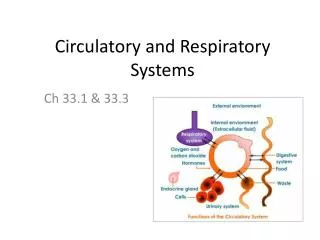
How are the two systems controlled? The Circulatory and Respiratory Systems Autonomic nervous system What is the FUNCTION of the circulatory system? • To bring oxygen to tissues/organs throughout the body • To remove carbon dioxide from tissues/organs throughout the body How does this happen? 392 2/7/11
The Circulatory System • Organisms with a few cells can obtain and remove nutrients and wastes by diffusion. These organisms do not have a circulatory system. • Vertebrates, like man have a CLOSEDcirculatory system. • The human circulatory system consists of the following three components: the heart, the blood vessels, the blood 392 2/7/11
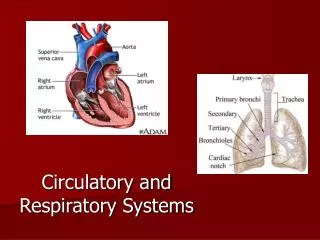
Heart Structure Heart is made up mostly of: Muscle, known as the MYOCARDIUM _________________________ It is surrounded by a protective sac known as the : PERICARDIUM ________________ 392 2/7/11
Heart Structure The heart has 4chambers. The top 2 chambers are called: right atrium, left atrium or atria _______________________________ Receive blood into heart The bottom 2 chambers are called: right ventricle, left ventricle ___________________________ Pump blood out of heart 392 2/7/11
The Heart Beat Circulation is a closed circuit. It is ONE-WAY. The heart has 4 main valves to control blood flow through the heart. Valves prevent backflow of blood. 392 2/7/11
Setting the Heart Pacemaker Sinoatrial Node and Atrioventricular Node Node = group of neurons sending electrical signals STEP 2: Blood out of heart STEP 1: Blood atria to ventricles 392 2/7/11
The Heart Beat Systole - Heart is pumping blood, contracting muscle • atria to the ventricles • ventricles to body or lungs Diastole – Heart is relaxing • atria fill with blood 392 2/7/11
What Makes that LUB-DUB Sound? The LUB: Closing off the atria Involves the TRICUSPID and MITRAL valves The DUB: Closing off the ventricles Involves the PULMONARY and AORTIC valves 392 2/7/11
Video of heart structure and function 392 2/7/11