Solving Systems of Linear Equations by Graphing
90 likes | 232 Vues
This guide explores how to solve systems of linear equations by graphing. A system is defined by two or more linear equations, for instance, 5x + 6y = 14 and 2x + 5y = 3. We illustrate how to find solutions graphically by checking specific points against the equations. Examples include determining if (1, 2) or (-4, 7) is the solution for a given system. Additionally, we discuss cases of parallel lines with no solution and coinciding lines with infinite solutions. Understanding consistent and inconsistent systems is key.


Solving Systems of Linear Equations by Graphing
E N D
Presentation Transcript
7.1 System of Equations Solve by graphing
A system of linear equations consists of two or more linear equations: • For example: 5x + 6y = 14 2x + 5y = 3
Ex 1) x + y = 3 5x – y = -27 Which one is the solution of this system? (1,2) or (-4,7) *Check (1,2)Check (-4,7) Is 1 + 2 ? 3Is -4 + 7 ? 3 3 = 3 yes 3 = 3 yes Is 5·1-2 ? -27Is 5·(-4)-7 ? -27 5 - 2 ? -27 -20 – 7 ? -27 -3 = -27 no -27 = -27 yes So (1,2) is not the So (-4,7) is the solution Solution of the system
Solve by Graphing Ex 1) y – x = 1 y + x = 3 y = x + 1 y = -x + 3 Therefore the solution of this system is (1,2) (1,2)
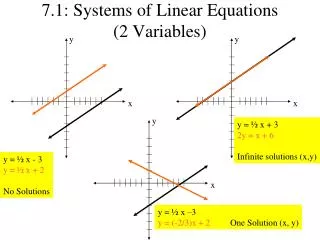
Solve by Graphing Ex 1) y = -3x + 5 y = -3x - 2 The lines are parallel, so there is no solution for this system of equations
Solve by Graphing Ex 1) 3y – 2x = 6 -12y + 8x = -24 There are infinite numbers of solution because the lines are coinciding
A system of equations is consistent if they have at least one solution • A system of equation is inconsistent if they have no solution