Download

1 / 7
70 likes | 173 Vues
A volcano is a mountain formed when magma escapes from beneath the Earth's crust and cools. Magma rises because it is less dense than surrounding rock. Key parts of a volcano include the magma chamber, crater, main vent, and various layers of ash and lava. Volcanoes can be classified into types such as shield, cinder cone, and composite, each with unique shapes and eruption styles. Shield volcanoes have wide, flat profiles, while cinder cone volcanoes are small and steep. Composite volcanoes exhibit characteristics of both types, often leading to explosive eruptions.

E N D
A volcano is a mountain that forms when magma escapes the through the crust and cools. What is a Volcano?
Magma comes to the surface because it is less dense then the rock. Remember, substances of lesser density float on top of more dense items. Why does magma come to the surface?
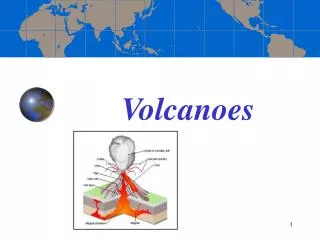
Magma chamber : • The large underground pool of liquid rock found beneath the surface of the Earth What are the parts of a volcano? • Crater: • a bowl-shaped formation at the top of a volcano. • Main Vent: • A point source of the Earth's surface where lavas ash and gas are erupted. • Lava: • Molten rock that reaches the earth's surface through a volcano • Layers of Ash and Lava: • As ash settles and lava cool, more and more layers accumulate. • Secondary Cone: • A second opening to the volcano attached to the main tube, allowing gas, ash and lava to escape.
Is wide and flat. It forms from a quiet eruption. Lava flows out quietly and for great distances Are all Volcanoes alike? Shield Volcano
Has tall, very steep sides. • Has explosive eruptions. • This eruption produces a lot of cinder and ash. Cinder Cone Volcano
Form from explosive eruptions. • Produce a lot of lava and ash. • Is small, with steep sides. Composite Volcano