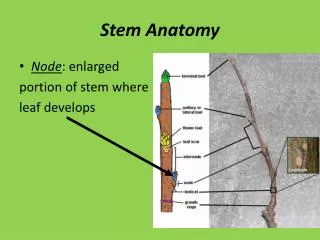

Stem Anatomy
E N D
Presentation Transcript
Stem Anatomy Lesson Plan: NRES B5-4
Anticipated Problems • What are the functions of a stem? • What are some of the external structures of stems? • What are some kinds of specialized stems? • What are the functions of the internal structures of stems? • What factors are involved in translocation?
Terms • cortex • heartwood • herbaceous stems • internode • lateral bud • leaf scar • lenticels • node • apical meristem • bud scale scar • bud scales • bulb • cambium • cladophyll • climbing stems • corm
Terms • translocation • tuber • water potential • woody stems • xylem • phloem • pith rays • rhizome • sapwood • scape • spine • stolon • terminal bud
Monocot Stems vs Herbaceous Dicot Stems • Monocot stems and herbaceous dicot stems have similarities and differences
Monocot Stems vs Herbaceous Dicot Stems Monocot Stems • Epidermis (provides protection) • Vascular tissues, xylem and phloem, are grouped into vascular bundles • __________________________________________ • ____________________________________________________________________________________ • Vascular bundles lack cambium, which would give rise to woody, secondary growth
Monocot Stems vs Herbaceous Dicot Stems Herbaceous Dicot Stems • Epidermis (provides protection) • Inside the epidermis is the_____________-composed of parenchyma, collenchyma, and sclerenchyma cells • Inside the cortex are the vascular bundles-________________________ • Xylem is on the inner portion of the vascular bundle; the phloem makes up the outside portion • ______________________________________________________________________________________
Monocot Stems vs Herbaceous Dicot Stems Herbaceous Dicot Stems • ______________________________________________________________________________________ • The vascular bundles are separated by masses of pith cells that extend into areas between the bundles - known as the _______________.
Cross Section of a Tree Trunk • When an individual views the cross section of a tree trunk, the age and two different colors of wood are evident: heartwood and sapwood.
Heartwood • _______________________________________________________________ • The xylem cells of the heartwood have filled with gums, resins, pigments, and tannins. • They provide strength and no longer function in conducting materials.
Sapwood • The lighter wood circling the heartwood is called the sapwood. • _____________________ ______________________
Age of a Tree • The age of a tree can be determined by counting annual growth rings. • ________________________________________
Translocation • The movement of materials through vascular tissues is known as ________________ • A dilute solution of water and dissolved minerals moves through the xylem: move in only one direction • ________________________________________________________________________________________
Water Potential • Water potential is involved in the movement of materials through the vascular tissues. Water potential is described as the free energy of water. • ____________________________________________________________________________________ • ____________________________________________________________________________________
Water Potential • Water moves from: • An area of higher water potential (less negative) to an area of lower water potential (more negative). • Water potential is a measure of a cell’s ability to absorb water. • ____________________________________________________________________________________
The Movement of Water • The movement of water and dissolved minerals begins with absorption into the plant. • Under moist soil conditions, the water potential in the root is more negative than that of the soil. • _________________________________________
The Movement of Water • ____________________________________________________________________________________ • Once in the xylem, the water and dissolved minerals are carried upward. • The plant uses no energy to move the solution because it is “pushed” from the bottom and “pulled” from the top.
Root Pressure • Root pressure moves water up the xylem. • ____________________________________________________________________________________ • The root tissues, full of water, exert pressure that forces water up the xylem. • ____________________________________________________________________________________ • The height at which solutions can be forced up the stem is limited.
Cohesion-Adhesion Mechanism • Translocation of water also is made possible by a cohesion-adhesion mechanism. • ____________________________________________________________________________________ • This tension creates a pull on water molecules the entire length of the stem. • The water is pulled up the stem from tension caused by the evaporative pull. • ____________________________________________________________________________________
Sugars • ________________________________________ • May be moved from the leaves to actively growing regions of the plant where they are used up. • ____________________________________________________________________________________
Sugars • The movement of materials through the phloem is a complex operation that is not fully understood. • __________________________________________ • Sugars move from the cells where they are produced to companion cells in the phloem. • ATP energy is used to make the movement of sugar to the companion cells possible. • ____________________________________________________________________________________
Sugars • The water potential in the sieve tube cell is lowered with the increased concentration of dissolved sugars. • _______________________________________ • ____________________________________________________________________________________ • When it reaches its destination, the sugar is transferred out of the phloem with energy provided by ATP.
Sugars • The water potential in the sieve tube cell (cont’d) • __________________________________________________________________________________ • __________________________________________________________________________________ • Water moves to surrounding cells with more negative water potentials.
Sugars • The movement of sugar through the sieve tube cells does not require energy. • ____________________________________________________________________________________