BACTERIAL GROWTH & PHYSIOLOGY
BACTERIAL GROWTH & PHYSIOLOGY. II MBBS Dr Ekta Chourasia Department of Microbiology. Growth. It is an increase in all the cell components, which ends in multiplication of cell leading to an increase in population.

BACTERIAL GROWTH & PHYSIOLOGY
E N D
Presentation Transcript
BACTERIAL GROWTH &PHYSIOLOGY II MBBS Dr Ekta Chourasia Department of Microbiology
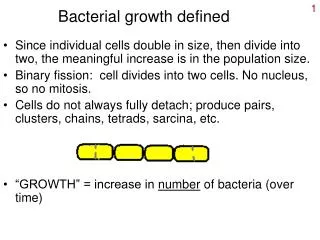
Growth • It is an increase in all the cell components, which ends in multiplication of cell leading to an increase in population. • It involves - an increase in the size of the cell & an increase in the number of individual cells. • Bacteria divide by binary fission. Dr Ekta, Microbiology, GMCA
Generation time • Interval of time between two cell divisions OR • The time required for a bacterium to give rise to 2 daughter cells under optimum conditions • Also called population doubling time. Dr Ekta, Microbiology, GMCA
Generation time • Coliform bacilli like E.coli & other medically important bacteria – 20 mins • Tubercle bacilli – 20 hrs • Lepra bacilli – 20 days Dr Ekta, Microbiology, GMCA
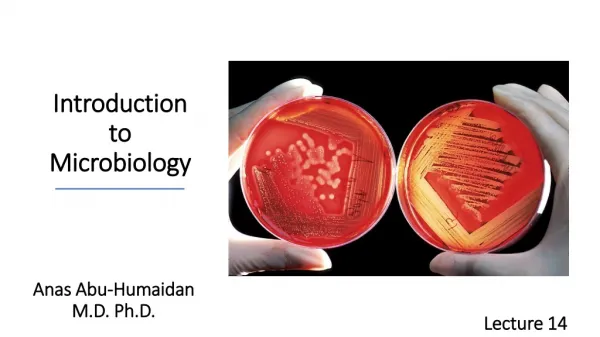
Growth form in Laboratory • Colony – formed by bacteria growing on solid media. (20-30 cell divisions) Each bacterial colony represents a clone of cells derived from a single parent cell. • Turbidity– liquid media - 107-109 cells/ml • Biofilm formation –thin spread over an inert surface. Dr Ekta, Microbiology, GMCA
Bacterial counts • Growth in numbers can be studied by bacterial counts. • 2 methods – Total cell count - Viable cell count Dr Ekta, Microbiology, GMCA
Total Count • Total number of cells in the sample – living + dead. • Can be obtained by : • Direct counting under microscope using counting chambers. • Counting in an electronic device – Coulter counter. Dr Ekta, Microbiology, GMCA
Total Count • Can be obtained by : • Direct counting using stained smears - by spreading a known volume of culture over a measured area of slide. • Opacity measurements using an absorptiometer/ nephalometer. • Chemical assays of cell components. Dr Ekta, Microbiology, GMCA
Viable Cell Count • Measures the number of living cells. • Methods – Surface colony count • Dilution method • Plating method • Number of colonies that develop after incubation gives an estimate of the viable count. Dr Ekta, Microbiology, GMCA
Bacterial Growth Curve • When a bacterium is added to a suitable liquid medium & incubated, its growth follows a definite course. • If bacteria counts are made at intervals after inoculation & plotted in relation to time, a growth curve is obtained. • Shows 4 phases : Lag, Log or Exponential, Stationary & phase of Decline. Dr Ekta, Microbiology, GMCA
Phases of Growth Curve • Lag phase – No increase in number but there may be an increase in the size of the cell. • Log OR Exponential phase – cells start dividing and their number increases exponentially. Dr Ekta, Microbiology, GMCA
Phases of Growth Curve • Stationary phase – cell division stops due to depletion of nutrients & accumulation of toxic products. - equilibrium exists between dying cells and the newly formed cells, so viable count remains stationary • Phase of Decline – population decreases due to the death of cells – autolytic enzymes. Dr Ekta, Microbiology, GMCA
Morphological & Physiological alterations during growth • Lag phase – maximum cell size towards the end of lag phase. • Log phase – smaller cells, stain uniformly • Stationary phase – irregular staining, sporulation and production of exotoxins & antibiotics • Phase of Decline –involution forms(with ageing) Dr Ekta, Microbiology, GMCA
Factors Affecting Bacterial Growth Temperature Atmosphere – O2 & CO2 H-ion concentration Moisture & drying Osmotic effects Radiation Mechanical & sonic stress. Dr Ekta, Microbiology, GMCA
Temperature • Vary in their temperature requirements. • Temperature range – growth does not occur above the maximum or below the minimum. • Optimum Temperature – growth occurs best, 37ºC for most pathogenic bacteria. Dr Ekta, Microbiology, GMCA
Temperature • Mesophilic – grows best between 25ºC and 40ºC. e.g. most bacterial pathogens • Psychrophilic (cold loving) – grows best below 20ºC e.g. Flavobacterium spps • Thermophilic – grows best at high temp, 55- 58ºC e.g. Bacillus stereothermophilus Dr Ekta, Microbiology, GMCA
Atmosphere • Depending on the O2 requirement, bacteria are divided into : • Strict (Obligate) Aerobes – require O2 for growth e.g. Pseudomonas aeruginosa • Strict (Obligate) Anaerobes – grow in the absence of O2 & may even die on exposure to O2 e.g. Bacteroides fragilis • Microaerophilic – grow best in the presence of low oxygen levels e.g. Campylobacter spp, Helicobacter spp Dr Ekta, Microbiology, GMCA
Atmosphere • Facultativeanaerobe – aerobic but can also grow in the absence of O2 e.g. Staphylococcus spps • Aerotolerant anaerobe – anaerobic, but tolerates exposure to O2 e.g. Clostridium perfringens • Capnophilic organism – requires high CO2 levels eg Neisseria spps Dr Ekta, Microbiology, GMCA
H-ion Concentration • pH range, optimum pH • Neutral or slightly alkaline pH (7.2 – 7.6) – majority of pathogenic bacteria grow best. • Lactobacilli – acidic pH • Vibrio cholerae – alkaline pH Dr Ekta, Microbiology, GMCA
Moisture & Drying • Water – essential ingredient of bacterial protoplasm. Hence drying is lethal to cells. • Effect of drying varies : T.pallidum – highly sensitive Staphylococci sp– stand for months • Spores – resistant to dessication, may survive for several decades. Dr Ekta, Microbiology, GMCA
Osmotic effects • More tolerant to osmotic variation due to mechanical strength of their cell walls. Radiation • X rays & gamma rays exposure – lethal Mechanical & Sonic Stress • May be ruptured by mechanical stress. Dr Ekta, Microbiology, GMCA
Bacterial Nutrition • Water constitutes 80% of the total weight of bacterial cells. • Proteins, polysaccharides, lipids, nucleic acids, mucopeptides & low molecular weight compounds make up the remaining 20%. • For growth & multiplication, the minimum nutritional requirements are water, a source of carbon, a source of nitrogen & some inorganic salts. Dr Ekta, Microbiology, GMCA
Classification of Bacteria Based on Nutritional Requirement • Phototrophs – Bacteria which derive their energy from sunlight. • Chemotrophs – Bacteria which derive energy from chemical reactions. • Organotrophs : require organic sources of hydrogen • Lithotrophs : require inorganic sources of hydrogen like NH3, H2S Dr Ekta, Microbiology, GMCA
Classification of Bacteria Based on Nutritional Requirement • Based on the utilization of carbon compounds, bacteria are classified as : • Autotrophs – can synthesise all their organic compounds by utilising atmospheric CO2 & N2. No medical importance. • Heterotrophs – unable to synthesise their own metabolites & depend on preformed organic compounds. Dr Ekta, Microbiology, GMCA
Growth Factors • Some bacteria require certain organic compounds in minute quantities – Growth Factors OR Bacterial Vitamins. • It can be : • Essential – when growth does not occur in their absence. • Accessory – when they enhance growth, without being absolutely necessary for it. Dr Ekta, Microbiology, GMCA
Growth Factors • Identical with mammalian nutrition • Vitamin B complex – • thiamine • riboflavine • nicotinic acid • pyridoxine • folic acid & • Vit.B 12 Dr Ekta, Microbiology, GMCA