Cortical Pathways for Visual Perception
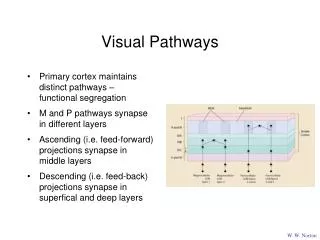
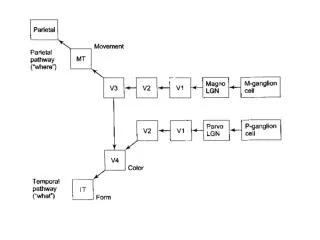
Cortical Pathways for Visual Perception. Output from occipital lobe follows two major fiber tracts Superior longitudinal fasciculus to parietal lobe Inferior longitudinal fasciculus to temporal lobe Ungerleider & Mishkin propose that these pathways form functionally distinct processing systems

Cortical Pathways for Visual Perception
E N D
Presentation Transcript
Cortical Pathways for Visual Perception • Output from occipital lobe follows two major fiber tracts • Superior longitudinal fasciculus to parietal lobe • Inferior longitudinal fasciculus to temporal lobe • Ungerleider & Mishkin propose that these pathways form functionally distinct processing systems • Dorsal (occipito-parietal) is the “where” system specialized for spatial analysis • Ventral (occipito-temporal) is the “what” system specialized for object perception and recognition
Dorsal and Ventral Functional Pathways • Pohl experiments reveal double dissociation • Landmark task: monkeys with bilateral parietal lesion have deficit, but monkeys with bilateral temporal lesion can learn task • Object discrimination task: monkeys with bilateral temporal lesion have deficit learning task, but monkeys with bilateral parietal lesion do not
Dorsal and Ventral Functional Pathways • Pohl experiments reveal double dissociation • Other bilateral lesion experiments show dissociation within temporal lobe • anterior temporal lesions disrupt visual memory • posterior temporal lesions disrupt visual discrimination
Dorsal and Ventral Functional Pathways • Pohl experiments reveal double dissociation • Other bilateral lesion experiments show dissociation within temporal lobe • Must lesions be bilateral to cause deficits? • Are dorsal and ventral pathways bilateral?
Dorsal and Ventral Functional Pathways • Ungerleiter and Mishkin combination lesion experiments • Ventral pathway is bilateral • Right striate + left inferior temporal lesions • No deficit in object discrimination • Severing corpus callosum creates deficit • Dorsal pathway is primarily unilateral • Right striate + left parietal lesions • Deficit in landmark task • Severing corpus callosum increases deficit
Dorsal and Ventral Functional Pathways • Neuron receptive field differences • Parietal lobe neurons • Large receptive fields • Specific to hemifield • More neurons have receptive fields outside the fovea than inside the fovea
Dorsal and Ventral Functional Pathways • Neuron receptive field differences • Parietal lobe neurons • Temporal lobe neurons • Large receptive fields • Not specific to hemifield • More neurons have receptive fields inside the fovea than outside the fovea • Majority of neurons respond selectively to complex stimuli
Dorsal and Ventral Functional Pathways • Kohler et al. PET study in humans supports "what/where" distinction • Position task: greater rCBF in right parietal lobe • Object task: greater rCBF biaterally at occipito-temporal areas
Dorsal and Ventral Functional Pathways • Kanwisher et al. PET study in humans fails to isolate cognitive functions during passive viewing of shapes
Computational Problems in Object Recognition • How to account for shape-based encoding? • Objects are more than the sum of their parts • Properties of object constancy • Viewing position • Illumination • Occlusion
Computational Problems in Object Recognition • Theoretical issues in object recognition • Frame of reference: object constancy across orientation • View-dependent • Separate representation of an object for each viewpoint • View-invariant • Critical properties used for object recognition • Major/minor axes, etc.
Computational Problems in Object Recognition • Theoretical issues in object recognition • Frame of reference • Shape encoding: hierarchical representations of increasing complexity • Salient features • Invariants: parallelism, symmetry, T-junctions, occlusion, etc
Computational Problems in Object Recognition • Theoretical issues in object recognition • Frame of reference • Shape encoding: hierarchical representations of increasing complexity • Salient features • Recognition by parts • Beiderman's geons : 24 fundamental 3-D shapes
Computational Problems in Object Recognition • Theoretical issues in object recognition • Frame of reference • Shape encoding • Neurophysiological representations • Hierarchical coding hypothesis • Object defined by Gnostic (or grandmother) cell: single neuron that represents"granny" activated by outputs from increasingly more complex detectors
Computational Problems in Object Recognition • Theoretical issues in object recognition • Frame of reference • Shape encoding • Neurophysiological representations • Hierarchical coding hypothesis • Ensemble coding hypothesis • Object defined by co-occurrence of complex feature detectors
Failures of Object Recognition • Visual Agnosia: Failure to recognize visual objects • Limited to visual modality • Not a sensory deficit • Not a memory deficit (anomia) • But deficits can co-occur • What can disorders of perception tell us about perceptual function?
Failures of Object Recognition • Patient GS • Normal visual acuity • Normal verbal memory
Failures of Object Recognition • Patient studies of visual perception deficits that support "what/where" distinction • Patient DF: bilateral occipital lobe lesions • Differentiates "perception for identification" from "perception for action"
Failures of Object Recognition • Subtypes of agnosia • Apperceptive agnosia: deficit in perceptual processing • Associative agnosia: "normal" perceptual processing, but deficit in linking percept to name
Failures of Object Recognition • Apperceptive agnosia • Deficits in perceptual processing may be subtle and may not be apparent in standard clinical tests
Failures of Object Recognition • Apperceptive agnosia • Warrington • RH patients had greater deficits in the Gollin Picture Test and Incomplete Letters Test than LH patients • RH patients with posterior damage have difficulty with object constancy • Unusual Views Test: can't recognize objects from unusual view • Shadows Test: can't recognize objects when illumination changes
Failures of Object Recognition • Associative agnosia • Warrington: Deficits are not at a perceptual level but at a semantic level • Patient FRA • LH occipito-temporal lesion • Could normally parse complex drawing into constituent objects, but could not name objects
Failures of Object Recognition • LH and RH patients both fail Matching-by-Function Test but for different reasons
Failures of Object Recognition • LH and RH patients both fail Matching-by-Function Test but for different reasons • Warrington's two-stage model of object recognition • Perceptual categorization occurs in the RH • Semantic categorization occurs in the LH • Perceptual categorization precedes semantic categorization • But, unilateral LH patients don't always have associative agnosia, usually requires bilateral lesions
Failures of Object Recognition • Integrative agnosia: some elements of apperceptive and associative agnosias • Patient HJA • Bilateral occipito-temporal lesion • Could recognize individual objects, but not line drawing of objects • Could perform Unusual Views Test • Could not recognize overlapping objects • Deficit in integrating and grouping features
Failures of Object Recognition • Integrative agnosia • May common problem in most agnosics • Other Integration failures • Patient CK • Closed head injury • Patient JR
Failures of Object Recognition • Category-specific agnosia: associative agnosia where deficit is specific to a semantic category • Patient JBR • Herpes simplex produced severe associative agnosia that was worse for living things than for inanimate objects
Failures of Object Recognition • Category-specific agnosia: associative agnosia where deficit is specific to a semantic category • Semantic knowledge is structured • Object categories • Tools, vehicles, etc. • Living vs nonliving
Failures of Object Recognition • Category-specific agnosia • Damasio suggests that nonliving activate kinesthetic associations that living things do not
Failures of Object Recognition • Category-specific agnosia • Gaffan and Heywood showed that normals made more errors to short latency exposures of living things than of nonliving things • Living things are more similar and share more features than nonliving things and are inherently more difficult to discriminate
Failures of Object Recognition • Farah and McClelland’s computational explanation for category-specific agnosia • Property-based organization of semantic system • Two main layers: semantic and input • Semantic has 3:1 ratio of visual and functional properties • Input is verbal and visual • Objects have visual and functional property codes • 7.7:1 for living things • 1.4:1 for nonliving things • Train model to discrimination 20 living and nonliving things • "Lesion" model and evaluate recognition accuracy
Prosopagnosia • Inability to recognize faces • Is there a separate face recognition system? • Evolutionary support • Phylogeny of face recognition • Primates show similar activation to faces • Development of face recognition • Neonates track faces longer than other stimuli • Cross-cultural interpretation of facial expression • Universal recognition of facial expressions
Prosopagnosia • Is there a separate face recognition system? • Evolutionary support • Neurophysiological support in primates • Baylis et al study on neuronal specificity to faces in the macaque • Farah's taxonomy of lesion foci
Prosopagnosia Majority of lesions in occipito-temporal area
Prosopagnosia • Is there a separate face recognition system? • Evolutionary support • Neurophysiological support in primates • Farah's taxonomy of lesion foci • Function neuroimaging in humans • Kanwisher et al. fusiform face area
Prosopagnosia • Can face and object perception be dissociated? • Dissociations between object and face perception • Right side up faces vs upside down faces • Patient CK • Could not identify objects in Arcimbaldo painting when right side up, but could identify face when painting was upside down • Patient WJ • Sheep farmer who had prosopagnosia for human faces but could still recognize sheep
Prosopagnosia • Can face and object perception be dissociated? • Dissociations between object and face perception • Tanaka and Farah: face recognition is more than the sum of parts
Prosopagnosia • Two systems for object recognition • Farah study of patterns of co-occurrence of prosopagnosia, visual agnosia, and alexia (acquired dyslexia) • Analytic processing • Holistic processing
Co-occurence of Prosopagnosia, Visual Agnosia, and Alexia Number of patients * possibly
Visual Imagery and Perception • Does visual imagery use the same neural mechanisms as visual perception?
Synesthesia • Involuntary experience of cross-modal association • 0.05% occurrence in population • More common in artists, novelists, poets, etc. • May be related to variation of fusiform area of temporal lobe