Understanding Indirect Objects in Spanish and English Grammar
This lesson focuses on the concept of indirect objects in both Spanish and English grammar. Students will learn what an indirect object is, how it receives the action of the direct object, and how to identify it by asking "to whom?" or "for whom?" Examples will illustrate the use of indirect objects, such as "I give the backpack to Rosa" and its Spanish equivalent. Additionally, students will practice replacing indirect object nouns with pronouns, enhancing their ability to speak and write in both languages.

Understanding Indirect Objects in Spanish and English Grammar
E N D
Presentation Transcript
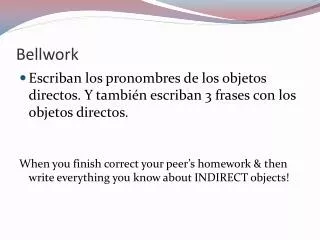
Bellwork • Escriban los pronombres de los objetos directos. Y también escriban 3 frases con los objetos directos. When you finish correct your peer’s homework & then write everything you know about INDIRECT objects!
What are indirect objects in English? • They receive the action of the direct object. • Answer the question: to whom? or for whom? the action is done • Examples: • I give the backpack to Rosa. • Who is receiving the backpack? ROSA • The Indirect Object(IO) is ROSA.
So what would it be in Spanish? • Yo doy la mochila a Rosa. • I gave the backpack to Rosa. Yo doy la mochila a Rosa. Rosa is our IO • Instead of always saying to Rosa, what could we change it to? • ~ Let’s put HER in there!
The Pros at IOs • Here’s how we say replace those indirect object nouns with their pronouns:
Placing the Pros • The IO pronouns accompany the NOUN it modifies OR replace the NOUN. The pronoun appears BEFORE the conjugated verbs. • Mamálesda el dinero a José y Ana. • Mom gives José and Ana the money. • Mamálesda el dinero. • Mom gives them the money. Accompanies Replaces José y Ana
Another Placing • When an infinitivefollows the conjugated verb, the indirect object pronoun can be placed before the conjugated verb or ATTACHED to the infinitive. • Levoy a vender mi coche a Sara. • I’m going to sell Sara my car. Comes before the Conjugated Verb • Levoy a vender mi coche. attached • Voy a venderle mi coche. I’m going to sell her my car.
Práctica • Ejemplo: El agente/vender/los boletos/ a nosotros • El agente nos vende los boletos. • Mi padre/pagar/cuatrocientos dólares/ a la agente de viajes. • Mi padre le paga cuatrocientos dólares. • Yo/dar/mi perro/ a ti. • Yo te doy mi perro. • Mi madre/regalar/un libro/ a mí. • Mi madre me regala un libro.