
Renaissance Breakthroughs
E N D
Presentation Transcript
Renaissance Breakthroughs Theoretical Advances
The Birth of the Renaissance • Renaissance • Rebirth • Revisit Classical ideas • Want to copy Greek and Roman styles • Fall of Byzantium, 1453 • Classically trained scholars flee Turks • Move to Italy • Reconquest of Spain • Library of Cordoba • Italian City States • Competition to outdo each other
Improving on the Classical World • New technologies / techniques available • Growing confidence • Re-examine Original Latin and Greek Texts • Notice some errors / inconsistencies • Attempt to improve on Classical techniques • Inquisitive and experimental
How to re-examine the world • Investigation • Columbus • Hmmm, I wonder if I can prove the world is round? • Observation • Copernicus • The stars and planets are moving in the wrong direction if the earth is the centre of the Universe • Experimentation • Galileo • Hmmm, If I put these two lenses together in a tube, I wonder what will happen.
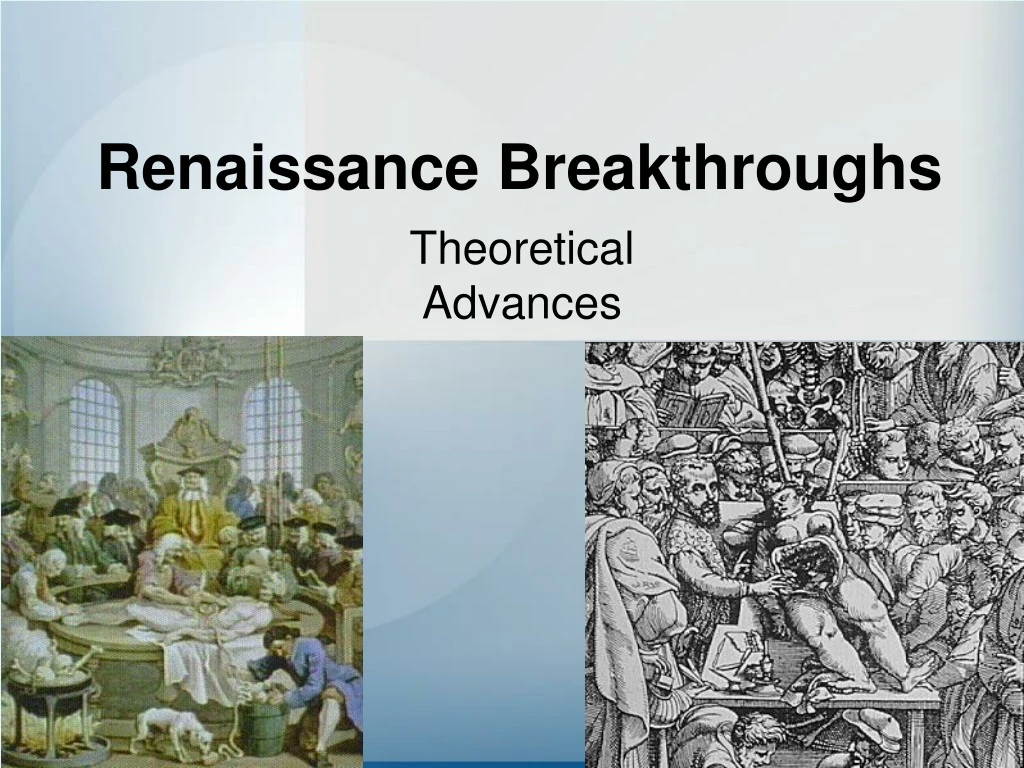
Renaissance Art • Observation • Examine nature itself • How does nature work? Studied plants, animals • Experimentation • Anatomy • Leonardo da Vinci • Dissected 10 bodies
Challenging Christianity • The Reformation • Martin Luther 1517 • Challenges Catholic Church and the Pope • Copernicus • Scientific contradiction of Christian teachings • Can the Christian church’s judgement be trusted on medical matters?
Why does this breakthrough last? • Printing Press • Gutenberg 1452 • Bible • Very cheap and easy to spread ideas • Challenges Catholic Church’s control over the spread of information • Monks handwritten manuscripts
Paracelsus1493 - 1541 • Full Name: • Aureolus Phillipus Theophrastus Bombastus von Hohenheim • University Lecturer in Basel, Switzerland • Challenged Galen • Burnt Galen’s books in front of his students • “Galen is a liar and a fake; Avicenna is a kitchen master. They are good for nothing. You will not need them. Reading never made a physician. Patients are the only books.” • Disagreed with 4 Humour Theory • Put forward the idea that the body was attacked from outside • Use minerals & magic to help protect the body • Mercury, Laudanum, iron and Sulphur
Padua Anatomical Theatre • Padua in Italy • Premier Medical Facility in Europe • More willing to dissect cadavers • However, cadavers still in short supply • Up to 300 observers • All observers within 10 metres of table
Andreas Vesalius1514 - 1564 • Studied in Paris • Observed gallows victims and decaying bodies of criminals • Smuggled parts home • Became professor of Padua at 23 • Conducted dissections himself • Students told to study the body for themselves rather than rely on others. • De Fabrica published in 1543 • Pointed out Galen’s errors • Jaw bone • Printing press allowed it to be made available to a wide audience
Ambroise Pare1510 - 1590 • Surgical Advances • Barber-Surgeon in French Army • Advance One • Problem • Surgeons cauterised gunshot wounds with boiling oil (to stop lead poisoning) • Painful • Shock • Infection • Crisis • Ran out of oil • Solution • Do not cauterise • Use natural ointment • Used by Romans
Ambroise Pare1510 - 1590 • Advance Two • Problem • Cauterisation used to stop bleeding on cut wounds / amputations • Shock • Pain • Infection • Solution • Ligatures • Use silk thread and needles to sew up bleeding vessels • Infection still a problem • Question 1-4 page 87
William Harvey1578 - 1657 • Student at Padua • Challenged Galen’s idea of new blood being created • experiments to show that blood flowed in one direction • Animals • Cadavers • Proved that heart was a pump • Blood recirculates • Calculated volume of blood • Published results showing his proof • Problem: Capillaries? • How useful was his discovery?
Homework • Page 90 • Use handout to help answer questions 1 to 5