

SlideServe
Menu
Préférences
© SlideServe · v2026

Enthalpy

bliss avatar
12 diapositives · 1.1K Views · Aug 02, 2014

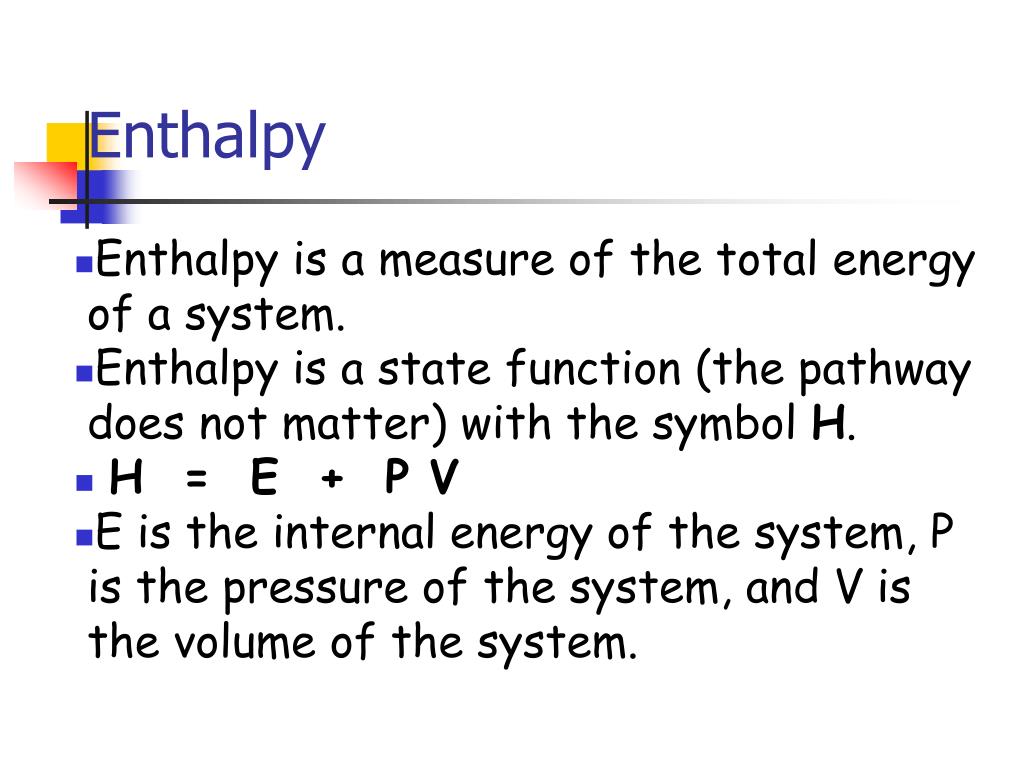
Enthalpy. Enthalpy is a measure of the total energy of a system. Enthalpy is a state function (the pathway does not matter) with the symbol H . H = E + P V E is the internal energy of the system, P is the pressure of the system, and V is the volume of the system.
Enthalpy - slide 1
01 / 12Enthalpy
1 / 17

Télécharger la présentation

Enthalpy
Une image / un lien ci-dessous est fourni (tel quel) pour télécharger la présentation

Politique de téléchargement : le contenu du site vous est fourni TEL QUEL pour votre information et votre usage personnel ; il ne peut être vendu, concédé sous licence ni partagé sur d’autres sites sans l’accord de son auteur.Le contenu vous est fourni TEL QUEL, pour votre information et votre usage personnel uniquement. Téléchargez la présentation en cliquant sur ce lien. Lors du téléchargement, si vous ne parvenez pas à télécharger une présentation, l’éditeur a peut-être supprimé le fichier de son serveur.Pendant le téléchargement, si vous ne parvenez pas à obtenir une présentation, le fichier a peut-être été supprimé par l’éditeur.

F I N

Plus de contenu associé

Transcription de la présentation
  1. Enthalpy • Enthalpy is a measure of the total energy of a system. • Enthalpy is a state function (the pathway does not matter) with the symbol H. • H = E + P V • E is the internal energy of the system, P is the pressure of the system, and V is the volume of the system.

  2. Heat at Constant Pressure • The change in enthalpy of a system has no easily interpreted meaning except at constant pressure, where DH = heat. • DH = Hproducts - H reactants. • At constant pressure, Exothermic means DH is negative. • At constant pressure, Endothermic means DH is positive.

  3. Enthalpy • When 1 mole of methane is burned at constant pressure, 890 kJ of energy is released as heat. Calculate DH for a process in which a 5.8-g sample of methane is burned at constant pressure.

  4. Calorimetry • The device used experimentally to determine the heat associated with a chemical reaction is called a calorimeter. • Calorimetryis the science of measuring heat. • Heat capacity is the amount of heat required to raise an object’s temperature one degree. • * C = heat absorbed . • increase in temperature

  5. Heat Capacity Specific heat capacity is the energy required to raise the temperature of one gram of a substance by one degree Celsius. units are J/oC.g or J/K.g. Molar heat capacity is the energy required to raise the temperature of one mole of a substance one degree Celsius. units are J/oC.mol or J/K.mol.

  6. The equation • The symbol for heat energy is q (J) • Molar heat capacity is C (J/mol K) • Temperature is T, change in temperature is T (K) • T is calculated by final temp-initial temp (Tf-Ti) • The symbol for number of particles is n (mol) • q = n C T • q = n C (Tf- Ti)

  7. ------Or------ • The symbol for heat energy is q (J) • specific heat capacity is c (J/ g K) • Temperature is T, change in temperature is T (K) • T is calculated by final temp-initial temp (Tf-Ti) • The symbol for mass m (g) • q = m c T • q = m c (Tf- Ti)

  8. Heat Capacity • Some common values are found in Table 6.1, p 251. • * The higher the value, the longer it takes to heat an object and the longer it takes for that same object to cool.

  9. If the pressure remains constant, the process is called constant-pressure calorimetry. • Calorimetry experiments can also be carried out under conditions of constant volume. • If DV = 0, PDV = 0, and DE = qv

  10. Constant-Pressure Calorimetry I • When 1.00 L of 1.00 M Ba(NO3)2 solution at 25.0o C is mixed with 1.00 L of 1.00 M Na2SO4 solution at 25o C in a calorimeter, the white solid BaSO4 forms and the temperature of the mixture increases to 28.1 C. Assuming that the calorimeter absorbs only a negligible quantity of heat, that the specific heat capacity of the solution is 4.18 J/oC g, and that the density of the final solution is 1.0 g/mL, calculate the enthalpy change per mole of BaSO4 formed.

  11. Constant-Pressure Calorimetry II • One piece of copper jewelry is placed at 100o C has exactly twice the mass of another piece, which is at 40o C. They are placed inside a calorimeter whose heat capacity is negligible. What is the final temperature inside the calorimeter? (C of copper = 0.387 J/g K).

  12. Constant-Pressure Calorimetry III • A 505-g piece of copper tubing is heated to 99.9 oC and placed in an insulated vessel containing 59.8 g water at 24.8 oC. If the vessel has a constant heat capacity of 10.0 J/K, what is the final temperature of the system? (C of copper = 0.387 J/g K)