Small Market, But Now Growing
180 likes | 300 Vues
The beef and dairy markets are evolving, driven by increasing urban incomes and changing consumption patterns. With beef demand growing by 5-7% and dairy by 10% annually, industry challenges like high input costs, limited competition, and weak farmer linkages persist. Despite these constraints, opportunities for investment and market entry are emerging. The government's ambitious plans for disease control and improved infrastructure could spur growth. Future scenarios suggest potential for significant development, hinging on the success of emergent farmers and competitive input availability.


Small Market, But Now Growing
E N D
Presentation Transcript
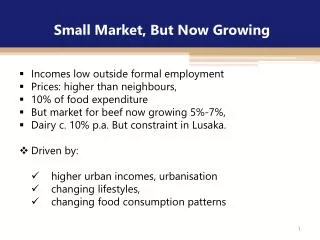
Small Market, But Now Growing • Incomes low outside formal employment • Prices: higher than neighbours, • 10% of food expenditure • But market for beef now growing 5%-7%, • Dairy c. 10% p.a. But constraint in Lusaka. • Driven by: • higher urban incomes, urbanisation • changing lifestyles, • changing food consumption patterns
3 Systems: Motives, Opportunities & Constraints Cattle Population (000)
Input Costs Undermine Competitiveness • Feed, drugs and medicine costs higher than RSA (feed+15%) • Poor access to vet services – govt, private • Fuel costs high, power expensive (self generated) • No rail, expensive road transport: Three times RSA • Finance inaccessible (collateral, short term) & expensive (spreads)
Beef: Competition Limited But Growing • Market power lies with industry • Few independent abattoirs, no formal wholesale market for beef. • Focus on capturing value, not efficiency. • Market concentration, integration are barriers to entry. • Weak supply linkages with farmers. BUT growing market, reasonable returns are attracting investment • Competition increasing: dominant players losing market share, new entrants will exert competitive pressure.
Dairy: Competition Limited But Better Linkages • Market power with industry. • Dominant processor – 50% market share, • Growing power of supermarkets = Large remain dominant But growing market, good returns causing better business models + investment • Major processor: collection centres, helps trace diseases. • Emerging farmers = 10% of market & increasing. • New producer dairies and cooperative dairies are being established. • Interest from large foreign companies but surplus capacity. • Still need investment in supply chains
Ministry Ambitious Plans – Consensus? • Disease free zones, Vet & Ext Services, livestock centres, research and breeding. New Acts. • Disease free zone: Disadvantage main production areas? Policing? • Meat and Dairy boards. Old problems? • Sustained political will? • Choice: Government driven Vs Public Private Partnership
Scenario 1: Business as Usual • Population growth 2-3% p.a.: 4 provinces • Industry growth = 2-3% above GDP. • Uncompetitive, so opportunistic exports • Limited job creation • Off take rates low • Traditional, small scale farmers may not escape poverty
Scenario 2: Major Industry in a Decade • Population grows 5% p.a. & spreads to other provinces • Industry growth 4-5% above GDP. • Exporter to region, emerging on world stage • Investment = job creation (Kenya = 700,000 dairy jobs) • Emergent farmers lead output growth • More traditional farmers become emergent • Traditional, small scale farmers escape poverty.
More Competitive Inputs Available • Diseases are controlled - govt. prevents (economic diseases), targets hot-spots - farmers prevent (management diseases) - efficient private sector supply of vet services & drugs - quarantine facilities enable exports • Breeding services improve - Govt research and breeding - Private AI services • Feed improves - farmer fodder banks, legumes, range management - feed companies support cheaper solutions • Extension services spread good practice - govt. services - private companies govt. Services
More Competitive Inputs Available • Transport & Fuel costs fall -lower tax on fuel for agric. & transport – green diesel -duties and taxes on spares - skills - finance for fleet • Access to Affordable Finance Increases - short & longer term for transition & emergent farmers - innovative products (i.e. Livestock, machinery collateral) - better business plans, loan supervision - affordable long term finance for processors • Power is available and cheaper in rural areas -less outages -off-grid solutions, renewable
Farmers Maximise Opportunity Traditional farmers: increase off take • security from drought, disease • better extension = adopting good practice • commercial incentives increase: supply chains, market centres Emergent farmers : increase productivity • access to short and long term finance • improved private sector supply of extension, training • better integration in supply chains Commercial farmers : invest, improve competiveness • cost of inputs falls, cheaper finance • access to infrastructure improves • cost of doing business falls • lower X – rate volatility Emergent farmer is key to faster growth and competitiveness
Efficiency Increases, Value Addition Beef • Increased investment in feed lots + attractive exports • Specialised businesses, wholesale market for beef, • Bigger, better utilised, abattoirs, • Lower transport, power costs • Access to finance • Quarantine facilities for exports Dairy • Investing in supply chains, higher capacity utilisation • Investing in market development (i.e. School milk) • Business development services for producer and coop dairies • Product diversification • Reducing Non Tariff Barriers
Policy & Institutions Improve Policies & Institutions are sustainable and sustained • policy contradictions reconciled • co-ordination between ministries improved • political interference, handouts fall Effective public private partnership develops • clear roles • PPP for disease prevention, vet & extension services, Govt. Institutions are more effective • service oriented • better managed Investment climate improves • input costs fall • cost of permits, licenses falls
The Prize: Major Industry in a Decade • Population grows 5% p.a. & spreads to other provinces • Industry growth 4-5% above GDP. • Exporter to region, emerging on world stage • Investment = job creation (Kenya = 700,000 dairy jobs) • Emergent farmers lead output growth • More traditional farmers become emergent • Traditional, small scale farmers escape poverty.
Way Forward? Over to You Thank You