Early Japan
This overview explores the early geography of Japan, emphasizing its isolation, reliance on rice farming, and the impact of natural disasters. The emergence of the Yamato clan in the 250-710 AD period is highlighted, showcasing their political structure, taxation through commodities, and the development of Shinto and Buddhist religions during the Nara period. Key cultural advancements are discussed, including the establishment of the first permanent capital, Nara, and the influence of Chinese writing and governance. This study provides insight into the socio-economic dynamics of early Japanese society.

Early Japan
E N D
Presentation Transcript
Early Japan By Abbie Gorman & Ria Sangsomwong
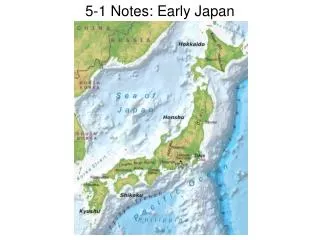
Geography • Separate rice farmers encouraged • the growth of popular democracy • Stimulated development of central • power in the hands of strong • emperors • The surrounding waters created very • dependent people • Growing crops and mountainous regions • proves the people are smart and independent • The mountains were difficult to live on. Most people lived on flat coastal plains.
Geography • Japan was isolated from the world until their emperors decided to visit other countries • Natural disasters; volcanoes and earthquakes; affected their ways of life • Limited farmland restricted their population growth • Japan had few natural resources • Japan was isolated from the world until their emperors decided to visit other countries • Natural disasters; volcanoes and earthquakes; affected their ways of life • Limited farmland restricted their population growth • Japan had few natural resources
Yamato Period • Began between 250-710 AD • Also called the Age of Great Tombs • Clans of Yamato had major advantages over neighboring clans • Fujiwara was the first capital during the Yamato Period in Japan in 694 AD • The second capital was Heijo from 710 to 784
Economy • Remained dependent on rice growing • Primarily a barter economy • Taxes were paid in rice, cloth, and other commodities by peasants who worked in public lands • At the beginning of the 7th century, coins were imported form China for tax collection
Government • Tribal states of various sizes and power were brought together gradually by a dynasty of Yamato clan rulers • Tribal groups/clans were the nobility/the Uji class • The farmers, scribes, traders, manufacturers, and immigrants were the occupational professional class called the Be • The lowest class were slaves
Religion & Military • The Japanese religion became more formalized for Shinto, the Way of Kami • Kami-an infinite number of natural spirits and could be called up • Warfare was a common feature • Weapons: swords, spears, and bow quivers • Horse figures were found-suggest the idea of calvary
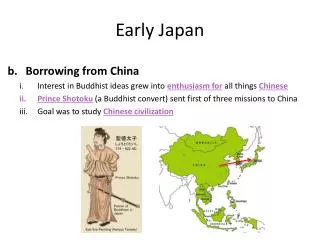
Nara Period • 710-784 AD • Sinicization and Buddhism were highly developed in the Nara Period • Nara was the countries first permanent capital • The Chinese characters were adapted to the Japanese language • Many Chinese manuscripts were copied • Legal codes based on Chinese models
Culture • Traditional technical methods of Japanese painting were established • Kakemono-the hanging scroll • Kojiki-the Record of Ancient Matters • Nihongi- Chronicles of Japan • Political conflict and the partial erosion of imperial authority characterized the second half of the Nara Period • Empress Koken • The last female emperor of significance • She ruled twice • Taking the name Shotokeu her second time • The last emperor Kanmu moved the capital to escape Buddhist influence
Questions • What was the Yamato Period’s taxes paid with? • a) Commodities • b) Money • c) Services • 2) True or Fasle: Warfare in the Yamato Period was common? • 3) Which religions developed in the Nara Period? Chose all that apply! • a)Buddhism • b)Islam • c) Sinicization
Work Cited http://answers.yahoo.com/question/index?qid=20071228143740AAEFNJm http://answers.yahoo.com/question/index?qid=20081209142838AAt6jV8 http://docs.google.com/viewer?a=v&q=cache:xg9WxBQzLVcJ:www.egusd.k12.ca.us/eddy/pdf/teacher%2520files/benson/PowerPoints/Japan/Benson%2520Sec%25201%2520Japan%2520Geography%2520Holt.pdf+geography+of+early+japan&hl=en&gl=us&pid=bl&srcid=ADGEESj9z3iuzQuOAF8yr3A_7oOmETd9keY-h4PrIei8g64DmfMe6y99MhovTXDwpyqZEPelrngEZVxlV4l6oe4ZuHd0RliUFBr6IyLaYXoYHfC1BOW0AKaH18scZ-AqO7PtCu9pvQHr&sig=AHIEtbR3n70VouN_DWDvMumY0mCAxCku_A http://en.wikipedia.org/wiki/Yamato_period http://www.angelfire.com/empire2/unkemptgoose/Yamato.html http://www.britannica.com/EBchecked/topic/403360/Nara-period http://www.infoplease.com/ce6/ent/A0858992.html https://www.courses.psu.edu/spcom/spcom483_sdp2/lectures/Bill/intro.html