Exploring Corporate Ethnography: Challenges and Methods in Practice
70 likes | 186 Vues
Join us for a comprehensive exploration of corporate ethnography in this two-part panel discussion, examining both conventional and technology-supported methods. Notable speakers include Julia Gluesing, Ken Riopelle, Marijke Rijsberman, Patricia Ensworth, and Keren Solomon, who will delve into the intricacies of ethnographic research as it applies to product and system development. Additionally, engage in a dynamic roundtable discussion that emphasizes micro-practices in everyday life and the importance of careful observation in understanding individual behavior.


Exploring Corporate Ethnography: Challenges and Methods in Practice
E N D
Presentation Transcript
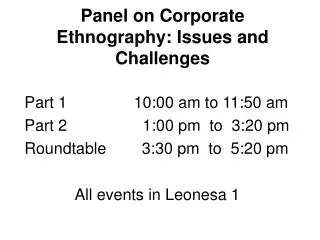
Panel on Corporate Ethnography: Issues and Challenges Part 1 10:00 am to 11:50 am Part 2 1:00 pm to 3:20 pm Roundtable 3:30 pm to 5:20 pm All events in Leonesa 1
Conventional Ethnographic Methods Julia Gluesing j.gluesing@wayne.edu
Technology-Supported Methods Ken Riopelle kenriopelle@wayne.edu
Ethnography Writ Small in the service of product development Marijke Rijsberman Cisco, Collaboration Software Group mrijsber@cisco.com SYSTEM description – interpretation – prediction of individual behavior FEATURE FEATURE FEATURE PRODUCT FEATURE FEATURE ethnography
Ethnography Writ Large in the service of system development Patricia Ensworth Harborlight Management Services LLC Patricia.Ensworth@HarborlightManagement.com Example: The Shadow Banking System The Federal Reserve Bank of New York - cited in the Financial Times, November 18 2010 http://www.ny.frb.org/research/staff_reports/sr458.pdf ETHNOGRAPHY
Rapid Ethnographic Techniques Keren Solomon kerensolomon@earthlink.net
The limits to speed in ethnographymcefkin@us.ibm.com “… I think that the attention to micro-practices and/or everyday life is extremely important, because it demands a time commitment and there is no way to rush everyday life. … Identifying what is significant can’t be done quickly, it seems, or at least there is no rapid means of guaranteeing that one is correct in one’s assessment. Attention to the micro-practices slows you down, so let’s slow down.” P. Rabinow, 2008, p. 95