Foundations of Cosmology: Key Concepts and Historical Milestones
This comprehensive overview of cosmology introduces essential concepts such as the relationship between energy and mass (E=mc²) in GeV, the dynamics of the expanding universe, and various observable quantities like the Hubble rate and energy density. It covers the historical development of cosmological theories from Einstein's general theory of relativity to the discovery of the cosmic microwave background radiation (CMB). The narrative highlights key figures like Hubble and Gamow, addressing significant theories and observations that shaped our understanding of the universe, including the Big Bang and dark matter.

Foundations of Cosmology: Key Concepts and Historical Milestones
E N D
Presentation Transcript
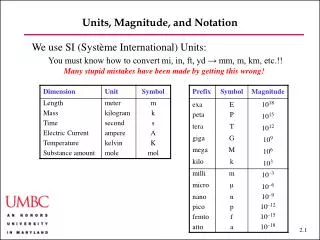
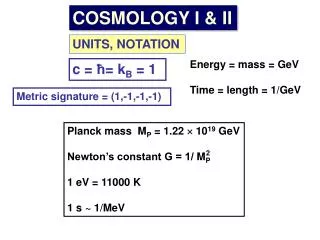
COSMOLOGY I & II UNITS, NOTATION Energy = mass = GeV Time = length = 1/GeV c = ħ= kB = 1 Metric signature = (1,-1,-1,-1) Planck mass MP = 1.22 1019 GeV Newton’s constant G = 1/ MP 1 eV = 11000 K 1 s ~ 1/MeV 2
Quantities, observables • Hubble rate = expansion rate of the universe = H • Energy density of particle species x: x= Ex/V • Number density nx = Nx/V • Relative energy density x = x/c • Relative He abundance Y = 4He/(H+4He) • Baryon number of the universe (nB-nB)/n • Scattering cross section ~ [1/energy2], (decay) rate ~ [energy] ~ n critical ¯
(cont) • CMB temperature T(x,y) = T0 + T(x,y) • CMB power spectrum P()~< T(x)T(y) > • Galaxy-galaxy correlators (”Large scale structure” = LSS) • Distant SNIa supernova luminosities
The starting point • expansion of the universe is very slow (changes adiabatic): H << scattering rates • Thermal equilibrium (+ some deviations from: this is where the interesting physics lies) • Need: statistical physics, particle physics, some general relativity
History of cosmology • General theory of relativity 1916 • First mathematical theory of the universe • Applied by Einstein in 1917 • Problem: thought that universe = Milky Way → overdense universe → must collapse → to recover static universe must introduce cosmological constant (did not work)
Theory develops … • Willem de Sitter 1917 • Solution to Einstein equations, assuming empty space: (exponential) expansion (but can be expressed in stationary coordinates) • Alexander Friedmann 1922 • Solution to Einstein eqs with matter: no static solution • Universe either expanding or collapsing
Observations • Henrietta Leavitt 1912 • Cepheids: luminosity and period related → standard candles • Hubble 1920s • 1923: Andromeda nebula is a galaxy (Mount Wilson 100” telescope sees cepheids) • 1929: redshifts of 24 galaxies with independent distance estimates → the Hubble law v = Hd
Georges Lemaitre 1927: ”primeaval atom” • Cold beginning, crumbling supernucleus (like radioactivity) • George Gamow: 1946-1948 • Hot early universe (nuclear physics ~ the Sun) • Alpher, Gamow, Herman 1948: relic photons with a temperature today of 5 K • Idea was all but forgotten in the 50’s
Demise of the steady state • Fred Hoyle 1950s • ”steady state theory”: the universe is infinite and looks the same everywhere • New matter created out of vacuum → expansion (added a source term into Einstein eqs.) • Cambridge 3C galaxy survey 1959 • Radiogalaxies do not follow the distribution predicted by steady state theory
Rediscovery of Big Bang • Penzias & Wilson 1965 Bell labs • Testing former Echo 6 meter radioantenna to use it for radioastronomy (1964) • 3 K noise that could not be accounted for • Dicke & Peebles in Princeton heard about the result → theoretical explanation: redshifted radiation from the time of matter-radiation decoupling (”recombination”) = CMB • Thermal equilibrium → black body spectrum • Isotropic, homogenous radiation: however, universe has structure → CMB must have spatial temperature variations of order 10-5 K
Precision cosmology • COBE satellite 1992 • Launch 1989, results in 1992 • Scanned the microwave sky with 2 horns and compared the temperature differences • Found temp variations with amplitude 10-5 K, resolution < 7O • Balloon experiments end of 90’s • Maxima, Boomerang: first acoustic peak discovered • LSS surveys • 2dF etc 90’s; ongoing: Sloan Digital Sky Survey (SDSS)
WMAP 2003 • High precision spectrum of temperature fluctuations • Determination of all essential cosmological parameters with an accuracy of few % • Big bang nucleosynthesis 1980’s → • H, He, Li abundances (N, ) • Planck Surveyor Mission 2008 (Finland participates)
Surprises/problems • Dark matter (easy, maybe next year) • Dark energy (~ cosmological constant?, very hard) • Cosmic inflation (great, but how?) • Baryogenesis (how?- Standard Model not enough)
timeline • Temperature ~<kinetic energy> • Thermal equilibrium, radiation dominated universe: T2t ~ 0.3/g1/2 degrees of freedom
String theory? GR: time coordinate begins E=1019 GeV Transition from quantum to classical Period of superluminal expansion (cosmic inflation) Cold universe E=1012 GeV release of the energy driving inflation (reheating) beginning of hot big bang and normal adiabatic Hubble expansion RT=const. thermalization; energy dominated by radiation = UR particles Supersymmetric Standard Model? sphaleron transitions wash away primordial baryon asymmetry T = 1 TeV
all Standard Model dofs present in plasma Higgs field condenses T = 200 GeV Electroweak phase transition particles become massive baryogenesis? t-quarks annihilate generation of relic cold dark matter? T = 80 GeV Z,W annihilate T = 5 GeV b-quarks annihilate T = 1.5 GeV c-quarks annihilate free quarks, antiquarks and gluons nq= ne= n= 3n/4 T = 200 MeV QCD phase transition _ _ p,n,p,n, + unstable baryons baryon-antibaryon annihilation
np=nn << n neutrino freeze-out T = 2 MeV kinetic equilibrium by virtue of np↔e+, pe-↔n etc. T = 0.7 MeV p and n fall out of equilibrium free neutron decay begins T = 0.5 MeV photodissociation of 3H e+e- annihilation end of free n decay T = 0.1 MeV synthesis of 4He begins synthesis of light elements almost complete t = 180 s matter-radiation equality Dark energy starts to dominate t = 3.8 × 10⁵ yrs photon-baryon decoupling CMB structure formation