Experimental Design
Master the art of note-taking and experimental design with these essential strategies. Learn how to identify main topics, key points, and organizational structures while taking notes. After class, clarify your notes by filling in gaps and regularly reviewing them to reinforce your understanding. Explore the fundamental concepts of experiments, including the importance of controlled conditions, variables, and hypotheses. Understand the roles of control and experimental groups, as well as dependent and independent variables, to effectively measure and analyze data.

Experimental Design
E N D
Presentation Transcript
Experimental Design CLASS NOTES
Note-taking Strategies: • Watch for main topic, key points, and organization of ideas • Clues from teacher – “first, second, etc…” • Make notes that highlight main ideas
Note-taking Strategies: AFTER CLASS – • Clarify notes – fill in missing info and highlight • Recite and review once a week • Before assessment – recite understanding main ideas.
Experiments Test A Hypothesis • Scientists use an experiment to search for cause and effect relationships in an experiment. • These changing quantities are called variables. • A factor, trait, or condition. • Experiments are used to test a hypothesis.
Experiments should be controlled. This means there should be two groups: • Control group: left alone, used as comparison • Experimental group: one thing is changed – this is the variable, or what you are testing
Everything else should be kept the same, except for the one variable that you are testing in the experimental group
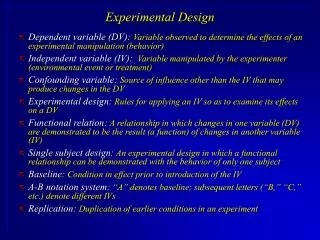
y Dependent variable • The dependent variable is what you are measuring or counting when you collect your data. This is plotted on the y-axis of a graph. Example: The height of the plants
X Independent Variable • The independent variable is what you are working with (manipulating) in an experiment. This is plotted on the x-axis of a graph. Example: The miracle grow and the plain water