Download
1 / 9
110 likes | 236 Vues
Robotic surgery enables surgeons to perform minimally invasive procedures using advanced technologies. It involves techniques such as tele-surgery, where surgeons can operate from remote locations, and shared-control systems, which blend human expertise with robotic precision. Since the first robot-assisted heart bypass in 1998, robotic surgery has expanded to various applications including coronary bypass, cancer tissue removal, and organ transplants. Benefits include smaller incisions, faster recovery, and reduced infection risk. The future aims for increasing automation and reducing human error in surgical procedures.

E N D
Robotic Surgery Shawn Volpe
Types of Robotic Surgery • Tele-surgical system • Surgeon preforms remote surgery from anywhere in the world that controls a robot. • Shared-control system. • Surgeon tells the computer what task to complete and the robot will carry out the task on its own. • Supervisory-controlled • Procedure solely done by the computer from a predetermined plan.
What is Robotic Surgery • Done under anesthesia. • Extremely small incisions or holes are made. One for the entrance of the endoscope. • Endoscope outputs highly magnified 3D images of area. • Surgeon moves devices to control robotic arms that make precise movements. • In May 1998, Dr. Friedrich-Wilhelm Mohr using the da Vinci Surgical System performed the first robotically assisted heart bypass in Germany.
Advantages • Much smaller incisions-1 cm diameter. • Quicker recovery period • Minimal scaring. • Less chance for infections • Movements can be smaller and more precise. • No hand tremors • Surgeon comfort • Surgeon can sit in a comfortable room without disease.
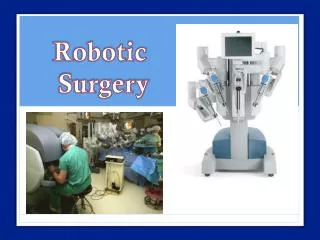
Da Vinci • The first and only commercial robotic surgery machine. (Tele-Surgical System) • Consists of… • 4 interactive robotic arms. • A Console for the surgeon to work from. • Endowrist joystick like control module. • State of the art vision system. • Robotic arms operate in real time as the surgeon moves the patented Endowrists.
Current Applications • Coronary artery bypass • Cutting away cancer tissue from sensitive parts of the body such as blood vessels, nerves, or important body organs • Gallbladder removal • Hip replacement • Hysterectomy • Kidney removal • Kidney transplant • Mitral valve repair • Pyeloplasty (surgery to correct ureteropelvic junction obstruction) • Pyloroplasty • Radical prostatectomy • Tubal ligation
Small space required Cheaper Easier to train and create Flexible and adaptable Accuracy and precise movements Preformed anywhere Robotic Surgery Human Surgery Stable and Untiring
Future Direction • The more technology equals less human involvement. • Main goal is completely removing human error. • Fully computerized and pre-calculated surgeries. More Supervisory controlled systems. • Trust in computers and technology is a true limitation.
Bibliography • "Da Vinci Changing the Experience of Surgery." Da Vinci Surgery. n. page. Print. <http://www.davincisurgery.com/>. • Dong, Babboo. "Robotic Surgery." n. page. Print. <http://biomed.brown.edu/Courses/BI108/BI108_2005_Groups/04/>. • Lanfranco, Anthony R. "Robotic Surgery A Current Perspective." Annals of Surgery. n. page. Print. <http://www.ncbi.nlm.nih.gov/pmc/articles/PMC1356187/>. • Miller, MD, Scott. "Robotic Surgery." n. page. Print. <http://www.nlm.nih.gov/medlineplus/ency/article/007339.htm>. • Somadi, David. "Robotic Surgery." Robotic Oncology. n. page. Print.