Download
1 / 8
80 likes | 202 Vues
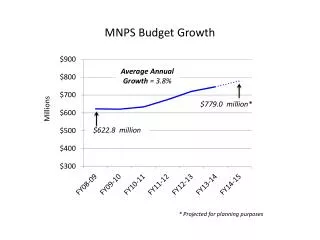
This document outlines the budget growth for Metro Nashville Public Schools (MNPS) with an average annual growth rate of 3.8%, reflecting a budget of $779 million. It includes projected cash outlays for charter schools with a significant average annual growth rate of 54.8%, projecting $54.2 million for planning purposes. Additionally, it discusses the potential shortfall in the operating budget, emphasizing the need for strategic priorities like consolidating under-utilized buildings, adjusting class sizes, and addressing overcrowding in key areas. The aim is to ensure fiscally responsible and operationally sustainable growth.

E N D
MNPS BudgetGrowth Average Annual Growth = 3.8% $779.0 million* Millions $622.8 million * Projected for planning purposes
Charter School Cash Outlays Average Annual Growth = 54.8% $54.2 million* Millions $4.6 million * Projected for planning purposes
Analysis: FY14-15 Operating Budget Potential Shortfall = $17.6 million Millions Charter growth Employee Compensation Other Required Additions * Assumes 2% revenue growth, for planning purposes
High-Leverage Options • Consolidating/closing under-utilized buildings • Raising class sizes in middle and high schools • Reducing the certificated workforce • Eliminating enhanced-options schools
Fiscally & Operationally Sustainable Growth • In November, the Metro Nashville Board of Public Education passed RS2013-4 “establishing priorities for deploying charter schools” during 2014 • Strategic priorities include: • Conversion of existing low-performing schools • New charters in exceedingly overcrowded cluster tiers FACT: The Glencliff and Overton elementary tiers are on track to hit 121%and 125% capacity, respectively, during the fall 2017-18 school year.
Common-Sense Approach • MNPS charter review process utilizes three “lenses” • Quality. Applications must meet NACSA quality standards. • Strategic priorities. Applications should address the school district’s stated needs. • Fiscal impact. Pursuant to TCA 49-13-108(b), applications should not be "contrary to the best interests of the pupils, school district or community.”